Lincolnshire’s High Sheriff
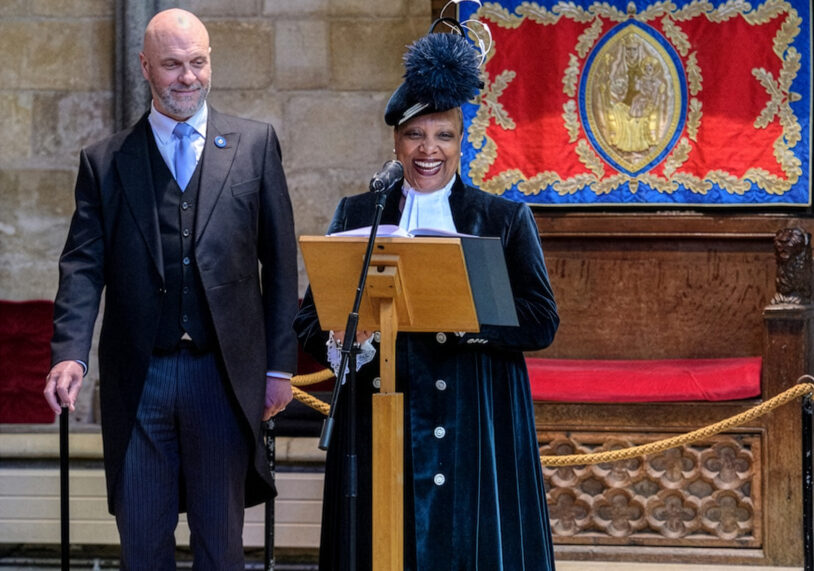
For more than 1,000 years, the role of High Sheriff has existed at the heart of county life. Once responsible for collecting taxes and maintaining law and order on behalf of the Crown, the office today has evolved into something rather different: a role dedicated to supporting the justice system, emergency services, charities and communities across the county.
Lincolnshire’s new High Sheriff, Sue Liburd, brings to the office an extraordinary breadth of experience spanning healthcare, the armed forces, humanitarian work, education and business leadership. Yet despite a career that has taken her around the world and into some of society’s most challenging environments, her story begins here in Lincolnshire.
Sue first arrived in the county in 1972 when her father, serving in the RAF, was posted to Grantham. Following his death while still in service, her mother made the decision to remain in Lincolnshire.
“Lincolnshire’s been home since 1972,” says Sue. “I went to school here and, like many young people, once I’d finished my A-levels I wanted to get away, explore and build a career. But home was always here.”
That career began in nursing. Sue trained first as a general nurse in Portsmouth before moving into mental health nursing in Exeter during the mid-1980s, at a time when Britain’s approach to psychiatric care was undergoing profound change.
“I wanted to be at the cutting edge of where mental health was going,” she says. “At the time there was a huge shift away from institutionalisation and towards care in the community.”
Working in Exeter, one of the UK’s pilot areas for the new approach, Sue witnessed first hand the changing understanding of mental health care and the importance of supporting people within their communities rather than isolating them in large psychiatric institutions.
“It was a hugely important period,” she says. “We recognised that people lived better, fuller lives when they remained connected to family and community, but it required investment and support.”
Following further training in midwifery in Southampton, Sue made what many would regard as an unexpected leap into the Army as a nursing officer. Growing up in what she describes as a “tri service family”, with her father in the RAF and her brother serving in the Navy, perhaps military life was never too far away.
“I thought if I was going to join the armed forces, I’d do something different and join the Army,” she says with a smile.
Far from limiting her opportunities, military life expanded them dramatically. Sue’s work soon moved far beyond nursing alone and into leadership, logistics and organisational management.
“The nature of being in the Army is that where you start isn’t necessarily where you finish,” she explains. “You get enormous responsibility very early. There’s a culture of developing people and recognising talent.”
One of her most significant experiences came during the Gulf War era, when she became involved in the closure and relocation of military medical facilities in Germany while ensuring services continued uninterrupted during a period of active conflict.
“You had hospitals to close, new facilities to open, staff being deployed overseas, families needing welfare support and services that still had to function every day,” she says.
“It taught me project management, leadership and how to handle large-scale change.” At the same time, Sue was also working in the emerging field of psychological trauma and post traumatic stress disorder.”
“During the late 1980s and early 1990s, understanding of PTSD was still in its infancy.
“We recognised people were experiencing psychological trauma, but PTSD as a recognised condition was still relatively new,” says Sue. “I genuinely believe I’ve seen a phenomenal change in how society understands mental health during my lifetime.”
Her work in trauma support continued after leaving the Army when she joined the British Red Cross in London. There she helped develop systems to support aid workers and volunteers exposed to humanitarian crises around the world, including the aftermath of the genocide in Rwanda.
“We were seeing aid workers exposed to horrific situations and recognising the psychological toll that could take,” she explains.
“The work was about ensuring people themselves were properly supported.”
From there, Sue’s career evolved once again, taking her into the charitable sector, social housing and eventually corporate transformation consultancy. Working with organisations including the Peabody Trust, she became involved in innovative projects designed to improve lives through employment, housing and community support. One initiative combined social housing with local retail spaces, helping vulnerable people secure accommodation, employment and stability simultaneously.
“You can transform lives when you create structure, purpose and safe communities,” says Sue. “And importantly, you create change not just for one generation, but for the next as well.”
Her later work in organisational change consultancy saw Sue advising businesses, public bodies and major organisations on cultural transformation and large-scale restructuring. Today she continues that work through her own consultancy business, Sage Blue, while also completing a PhD at the University of Lincoln focused on constructive disruption within large organisations. Despite her varied career, Sue sees a clear thread connecting every chapter. “It’s always been about people and community,” she says.
“How do you help people thrive? How do you support organisations and communities to become healthier, fairer and stronger?”
Returning permanently to Lincolnshire in 2009 following the death of her mother, Sue says she rediscovered everything she loved about the county.
“I truly love this county,” she says. “Lincolnshire has incredible diversity. We have coastline, countryside, market towns, industry, villages and the city. There’s a real richness to it.”
She also believes Lincolnshire’s sense of community remains one of its greatest strengths. “People still speak to each other here,” she says. “There’s still that sense of connection and community spirit.”
That commitment to community service eventually led Sue towards the role of High Sheriff, although the appointment process itself remains steeped in secrecy and tradition. Potential candidates are identified years in advance by an independent nominations committee before ultimately being approved by the monarch through the ancient ‘pricking’ ceremony.
“You’re selected because people believe you care about the county and will serve for the right reasons,” Sue explains. “It’s entirely voluntary and self-funded. It’s not something people do for personal gain.”
Today the role centres around supporting Lincolnshire’s police, courts, prisons, probation service, emergency services and the many charities working across the county to prevent crime and strengthen communities.
“It’s about visibility, encouragement and support,” says Sue. “The voluntary sector and our public services do extraordinary work and often don’t receive the recognition they deserve.”
For Sue, the role represents the culmination of decades spent working across health, justice, education, business and community life.
“There’s an old idea that if you live within a community, you should give something back to it,” she says. “That’s always been important to me.” And after a lifetime spent helping others navigate challenge, change and uncertainty, Lincolnshire’s High Sheriff seems perfectly placed to continue doing exactly that.
Sue Liburd is Lincolnshire’s High Sheriff for 2026/2027.