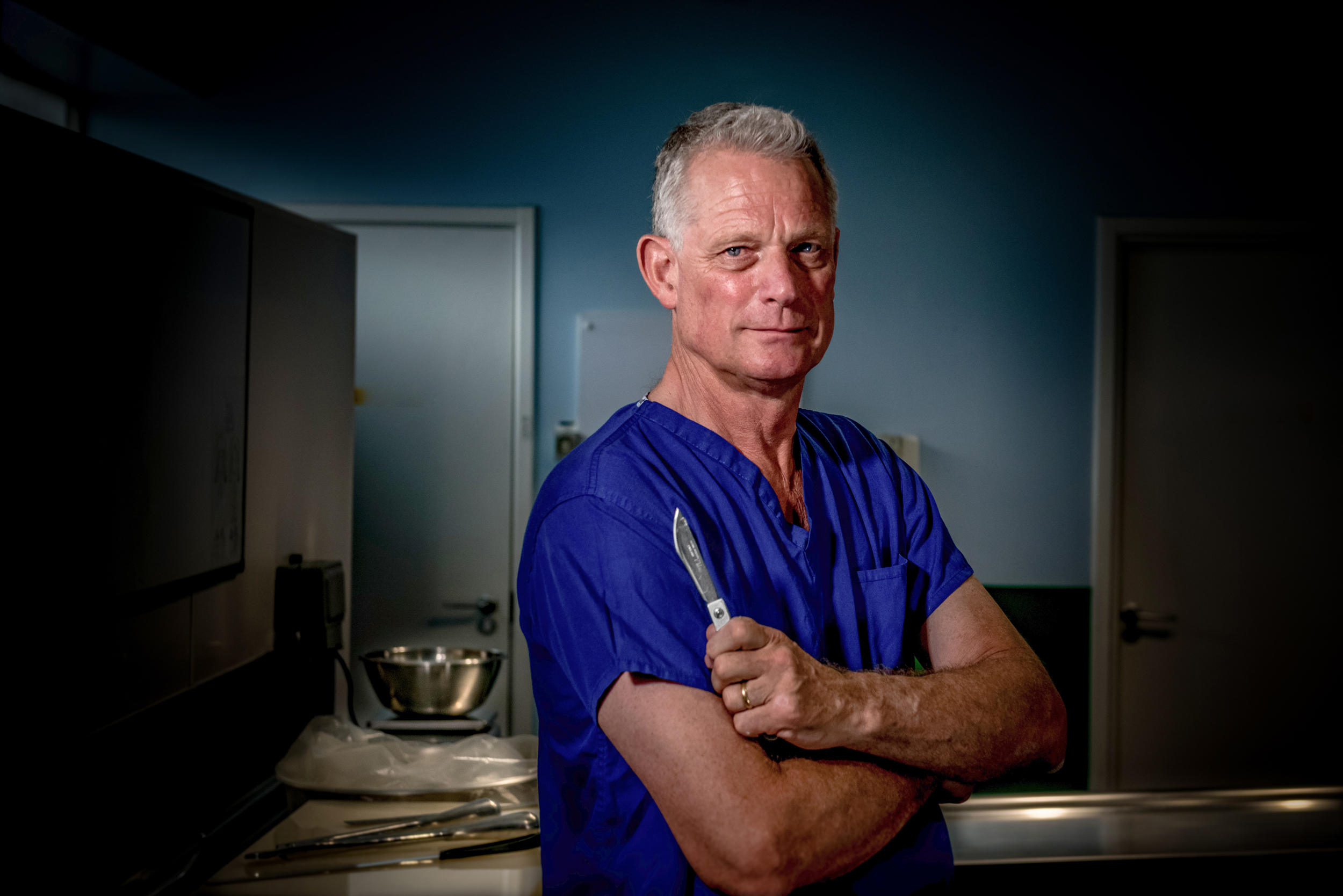
Dr Richard Shepherd, forensic pathologist
Husbands and wives, children, siblings and friends: tell them you love them. That’s the wisdom that comes from four decades as a forensic pathologist…
Fear? Morbid curiosity? A fascination with the science? Whatever the reason for the interest, it’s definitely there. If you meet Dr Richard Shepherd and engage in the usual subject of small talk, ‘what do you do for a living?’ you might get a more intriguing answer than the usual job title suspects of IT, marketing, accountancy or sales.
Richard is a forensic pathologist, and over his 40 years in the profession, he has overseen 23,000 post-mortems or autopsies. The two terms are used interchangeably in the NHS and mean the same thing. The latter term is favoured in the US, and has, like many Americanisms, permeated modern discourse, predominantly among those in the medical and legal professions, rather than among forensic pathologists, for there are relatively few of them: just 35 or 40 in the whole country.
Richard is a lovely interview subject: warm, open and affable. He’s at home in Cheshire in his study with his Jack Russell asleep next to him and we both have a cuppa on the go. All very civilised, that is, until talk turns to Christmas Day massacres, drowning in pig slurry and his best-known investigations, which have included the late Diana, Princess of Wales’ death in the Pont de l’Alma tunnel, the awful murder of Stephen Lawrence, and the crimes of Harold Shipman. Richard has provided his expert insight into all of the above.
The book that changed everything
Richard’s interest began at school. “I was 13, 14, maybe something like that,” he says. “A friend of mine, whose father was a GP, brought a forensic pathology textbook into school that he’d nicked off his dad’s bookshelf.”
“Most of my classmates said, ‘oh, how disgusting, I’m going to go and play football.’ But I was absolutely taken in by this, because I never realised that doctors help the police in solving crimes and doing things like that. And I was just completely sold.”
“My dad was a very wise man and realised that if I was interested in this subject, no matter how macabre it seemed, it was also a way of getting me to study and work for my O levels and A levels. So that’s what happened, he encouraged it.”
“That encouragement took me to medical school and carried me through my medical training, right up to choosing pathology and then forensic pathology. However I also really, really liked obstetrics. I liked the idea of delivering babies so I toyed with the idea of pursuing that specialism, but in the end stuck with forensics and dead people.”
“Someone once said that on the wheel of life, birth and death are next to each other. I really do think I’ve been lucky to have found a career in my teens though,” he says. “To qualify, enjoy the learning and pursue an absolutely wonderful career. I really feel quite blessed.”
A rare profession
Most people, Richard says, have no idea how the system they see on television actually works, starting with how few people do his job. Pathology, he explains, is a branch of medicine like surgery or obstetrics, with its own sub-branches: those who look at tissue under a microscope, those who study the chemicals in the bloodstream, the immunologists, the bacteriologists. And then, right at the end of the chain, “forensic pathology is a teensy weensy sub-sub-branch of histopathology, because in the country there’s only about 35, 40 of us.”
“That’s all there is,” he says. “But then remember, those are the ones that deal with the very highly specialised suspicious deaths, the possible murders.” Those specialists sit on what is now called the Home Office Register (it used to be the Home Office List), and the police are obliged to use them for the most serious cases. These days, Richard works exclusively for coroners. Almost none of it is salaried.
“Very few forensic pathologists have a salaried job. Most of them are basically self-employed,” on call for a week or two out of every month or two, paid by the police and the coroner when the phone goes.
The distinction between coroner and pathologist, he adds, is one people routinely muddle. A coroner is legally qualified, not medically, and works within a tiered structure of senior, area and assistant coroners. And an inquest, he stresses, is not a trial. “There are no accused and defendants. An inquest is a fact-finding event, and they’re seeking to find the truth to assist the coroner in coming to their conclusion.”
Putting together the jigsaw
Since every person and every circumstance is different, there’s no definitive list of what Richard is looking for when he’s called to investigate a death.
“It’s just like finding bits of jigsaw puzzles and putting them together. You never have all of the pieces, but you hope to get enough of the jigsaw to be able to work out what’s gone on. If we’re dealing with the police, then I will often attend where the body is found to see it in situ, because that can be very, very important to understand the environment in which they came by their death.”
From there to the mortuary, where a surprisingly large team assembles: investigating officers, crime scene managers, photographers. And always, always, they look inside. “We’d never just stop at the external,” he says. “Even where the cause seems obvious, such as when somebody has plainly been shot, we still look inside to see exactly what has happened with the bullet wound, but also to see if there’s any natural disease processes going on.”
Richard cites the hypothetical scenario of a body at the foot of a staircase. “Do the injuries that we find on them match those I would expect to see in someone who’s fallen down the flight? Were they concrete stairs? Were they domestic stairs? Did they have carpet on them? Did they land on a pile of clothes at the bottom, or was it actually a tiled floor? And when I look at their forehead, there’s the crisscross pattern of the tiled floor in the bruising.”
Thereafter, why did they fall? A medical problem prior to the fall or an external cause of the fall itself? The task is to ask not just ‘what happened’ but ‘how and why.’
It is a collaborative business, too. He describes colleagues who examine pollen found under fingernails, in shoes, in the nose, because pollens differ by species and by season, and can place a body near an oak tree, or in a particular field, or somewhere else entirely. “We all work together to achieve an understanding.”
How most of us actually die
Here is the thing Richard would most like people to understand, and the thing that sits at the heart of his forthcoming show at New Theatre Royal in Lincoln on Monday 19th October. “Everyone thinks, talking to me, that everyone dies with an axe in their head, or a gunshot, suffering trauma and in pain and agony,” he says. “No, absolutely not. They just drift away. And that’s how hopefully I will go too.”
The numbers bear him out. Something like 75 to 80 per cent of deaths never trouble a coroner at all, certified by a GP or hospital doctor as expected and natural. Of the remainder, only a fraction go to post-mortem, and fewer still to inquest. Disproportionate fiction and non-fiction attention (relative to the number of real-life occurrences) in the media serves to exaggerate awareness and fear of murders in the UK which, he estimates, run to a few hundred a year. “It’s very small numbers, which is why we only need 35 to 40 forensic pathologists in the country.”
“Most people just drift; their body runs out of steam. The heart just stops working, or they have a disease in their lungs, they have a nasty chest infection and they’re not getting enough oxygen and they just drift away, or they have a stroke. The vast majority of people will die a peaceful and quiet death, hopefully with friends, family around them, but not always.”
He offers for consideration the case a colleague had just described to him: a woman of about 96 who lived in a block of flats and loved to sunbathe on the roof. Neighbours noticed she had not come down. “When they went up, she was on her deck chair with a book open in her lap, just sunbathing, quietly sitting in the sun, and she just died quietly, aged 96.”
“My wife asked, ‘But did she finish the book?’ Apparently she hadn’t. But that’s what the afterlife is about; catching up on these unfinished books, isn’t it?”
Is there a worst way to go? He resists the question, then answers it anyway. “I think everyone has their own personal worst way to die. What comes to mind for me is falling into a vat of pig slurry, which is absolutely horrid. I’ve seen three or four of those in my career.”
And drowning, which is popularly supposed to be peaceful? “They do say that drowning is and can be quite peaceful. And I think that is based on people who have been rescued in the nick of time and then say, ‘oh, actually, yeah, I was quite happy, I was drifting off.’”
“People say, I was just quietly floating along and there was a bright light and a friendly face came to see me and said, ‘come with me and we’ll go off together.’ Then these bloody paramedics came and jumped up and down on my chest.”
“I know so many awful ways to die though so I think I would just stick quietly with drifting off and wandering through the pearly gates hand in hand with someone that I love. That would be good.”
“We are not for a side. We are for the court”
The question of famous cases comes up, inevitably, and Richard is careful with all of them. On Diana, Princess of Wales, he points out that a crash which looks self-explanatory has generated more theories than almost any death he can think of and was in fact very complicated.
His other experience includes the murder of Stephen Lawrence and the crimes of Harold Shipman. “I was working with Shipman’s defence team, looking at the evidence produced by my colleague acting for the police.”
That needs explaining, and he explains it with some force, because it goes to the core of what he believes the job is. “The one thing that we always say as experts is, we’re not ‘for’ a side. We’re for collecting the evidence faithfully and truthfully, and looking at it in the same way. We are ultimately working for the court.”
“We’re called by the police, but we’re not there to make sure that a person ‘goes down.’ We’re there to find the evidence. If the person goes down, then we’ve got to be sure that it’s fair and truthful. A hunch might start you off looking for the evidence, but if you can’t find the evidence, you can’t present it to the jury. It is the truth and it will be tested.”
And it will be tested in front of twelve people who, Richard assumes, know nothing whatsoever about forensic medicine. “I’d be surprised if they ever did. Maybe the only forensic science they’ve seen is Silent Witness on the TV.” The job, then, is not only to find the evidence but to hand it over in a form a jury can carry into the jury room and actually use. “That’s the bottom line. That’s what we’re doing this for.”
Telling the family
I ask Richard about the heartwarming moments, not the macabre elements of the job, and immediately he talks about relatives. “I always remember that the most important people are the relatives of the deceased,” he says. “The deceased was the most important person, but now we can’t talk to them.”
Because his cases are almost always sudden, the families arrive without any of the preparation a long illness allows. “This person was alive one minute, and then ill, and then maybe dead the next.”
What he offers them is the truth, completely and without decoration, and his reasoning is worth noting. “The one thing I’ve learned is, if people don’t understand, they tend to speculate, and the result is always worse than the reality of the situation.”
“We give them the truth, we don’t hide anything. You can never lie. You always have to tell the truth and say, ‘this is what happened.’ Either ‘yes, they felt some pain, but it would only have been for a short time.’ Or, ‘no, I’m sure they wouldn’t have felt any pain.’ Whatever is the truth.”
“It enables them to carry through this grieving process and to reach their own equilibrium in the end. And that’s where the heartwarming things can come, talking to relatives, helping them understand and appreciate what’s gone on.”
The corner before home
How do Richard and his colleagues do the job and then go home? “There’s dark humour in the mortuary, necessary as a pressure valve, but I can honestly report that it’s never disrespectful. A little bit of humour can also keep people focused on the job they’re trying to do.”
“When you walk through the door of the family home and your young children are there, they don’t give you a fraction of a second to catch your breath. So I would stop round the corner from home and just take that minute to talk myself out of work mode and back into family mode. In doing so, I can go through the door and go straight into looking at pictures painted at school, or straight into the garden to play football.”
“It’s a necessary way to be able to give to my children and my wife and the family the things that they needed, without jarring and stressing myself by still having my mind focused on work when I had to have it focused on something else.”
Catharsis, Richard says, was part of why he started writing about his profession in the first place (the other reason is that people are always fascinated by his work). “The challenges are huge. How do you manage to go and look at a dismembered body and then go home and have roast beef and Yorkshire pudding and all the trimmings with the family on a Sunday? How, on Christmas Day, do you go and see someone who’s massacred four members of their family, and then go back and sit and eat turkey and open presents with the children? It is an interesting dichotomy in your life.”
What Silent Witness gets wrong
As for fictional portrayals of his profession, Richard is generous about the most obvious of them, Silent Witness. “It doesn’t misrepresent it,” he says. “In order to avoid a cast of millions the drama compresses several real jobs into one character, so the pathologists go out and interview people, which doesn’t happen. But it makes for a better story.”
“The bigger distortion is the clock. On screen a case is solved within the hour. In life, we will sometimes be working on them for a month, or six weeks, or three months, before we get to the solutions. Often that is simply queueing: toxicologists with a lab full of samples and a fortnight’s backlog, or a forensic science laboratory with four thousand bullets to look at before they reach mine. Reality wouldn’t make for snappy television. A pathologist sitting drinking a cup of coffee, looking thoughtfully at a computer. It would be like watching paint dry.”
“Life really, really is not fair”
Forty years and 23,000 autopsies must leave a person with a certain perspective. They have. The case Richard reaches for is not a famous one. It is a young woman driving along a motorway, doing nothing wrong at all, when a wheel came off a lorry travelling the other way. It went onto the hard shoulder, hit something (possibly a brick), was flung towards the central barrier, hit something again, bounced clean over, and struck her car square on.
“And you just think, ‘that is just so unfair.’ She was doing absolutely nothing wrong. Life was good, life was moving on, and then a freak accident killed her. If the profession teaches you anything, it’s to never forget to tell someone you love them, because actually you might not have another chance.”
Offered the line ‘Plan like you’ll live forever, but live like you’ll die tomorrow,’ he considers it. “I’d not heard that before, but yes, I think that is absolutely right, because it’s not going to happen. Luck. Good luck, bad luck. Just occasionally, on the other side of that coin, somebody does win the lottery. And this is the reverse of winning the lottery, isn’t it?”
Coming to Lincoln
Time of Death: More Unnatural Causes follows Richard’s sell-out tours of 2021 and 2022, and it is squarely aimed at the rest of us rather than at the profession. He is plainly delighted by the whole business, and particularly by the bit at the end.
“There’s the tour, which is great fun, because I do get to meet people at the end and talk about things and sign books. It’s just nice, that people are interested and keen to come along and see me.”
As to why we are all quite so fascinated, he has a theory, and it is not a comfortable one. “I think it is just fear. Fear, interest, fascination by the unknown. We all know that people get murdered. We all know that people die in accidents.” Something surfaces on the news, and for a moment everyone thinks the same thought. “What would I do? And I think that’s what creates the interest.”
Which is, more or less, what the evening sets out to answer; how it might happen. Which is not with an axe in the head, as it turns out. Just, for most of us, quietly, in the sun, with a book we never finished.
Dr Richard Shepherd is the author of Unnatural Causes and The Seven Ages of Death. Time of Death: More Unnatural Causes comes to the New Theatre Royal, Lincoln on Monday 19th October, see www.newtheatreroyallincoln.co.uk or call 01522 519999.