Steam Railways in Lincolnshire
This month we’re adding coal to the fire and setting off on a heritage journey with the Lincolnshire Wolds Railway Society and its newest fireman, Andrea Laister
Remember your driving test? Mine was with a stern gentleman with an officious moustache and regulation clipboard to bang on the dashboard, signalling the need to perform an emergency stop.
I must have done something right as I passed, although I do remember what a nerve-wracking experience it was, so I have considerable sympathy for anyone going through the trauma today… especially as the driving test has become more more difficult.
As for Andrea Laister, she too can also relate. Having moved from Oxfordshire to Lincolnshire in 2022, her interest in steam railways, enjoyed a resurgence as she was living at North Thorseby, near Lincolnshire’s only standard-gauge heritage railway, the Lincolnshire Wolds Railway.
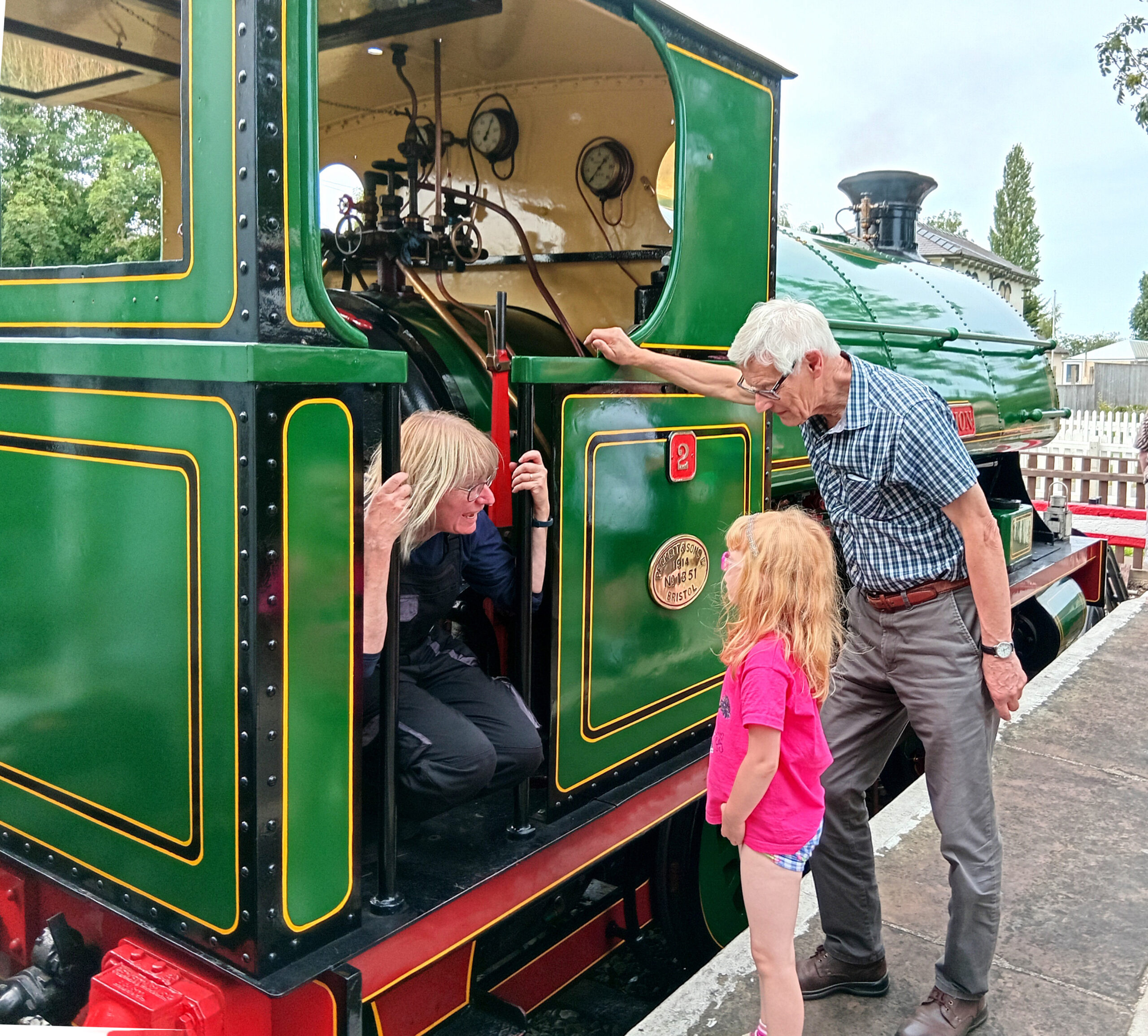
Andrea is about to climb onto the footplate of the heritage railway’s Lion locomotive, whereupon she will face something not too dissimilar to a driving test, fulfilling her aim to become the railway’s latest fireman on board the steam train.
The Heritage Railway Association is the UK’s trade association and professional support body for the heritage rail sector. They’re also the people who have the authority to declare Andrea an official Fireman. According to the HRA there are over 170 operational railways and over 600 miles of track, allowing 13m visitors every year to enjoy the sight, sound and scent of heritage rail travel.
“I’ve had an interest in steam railways from an early age as my father introduced me to the sights, smells and sounds of the locomotives when I was very young,” says Andrea.
“He also volunteered as a station master on the South Devon Railway, so I’m proud to be following in his footsteps.”
“I have had a couple of ‘driver’ experiences previously, at the Severn Valley Railway and the Great Central Railway, but these were one-off experiences, and we didn’t live close enough to a preserved railway for me to participate or volunteer on a regular basis.”
“When I moved so close to the Lincolnshire Wolds Railway, my interest was re-ignited and I was keen to volunteer.”
“I started by suggesting a few pots of flowers at North Thoresby station may enhance its appearance, so began there with a little gardening. I then started to attend on running days so that I could help our station master, Norman, and cover for him if he ever needed or wanted to be absent.”
“This led to one of the engine drivers seeing my enthusiasm and I was offered a footplate ride, which then became an offer to spend a day to see what the duties of a fireman would be, which then led to me starting my training as a cleaner and fireman! I started in autumn 2024 and have now completed about 15 running days on three different engines, Spitfire, Cranford and most recently, Lion.”
The heritage railway opened in 1848 and closed in 1963 as Dr Richard Beeching took an axe to the rail network.
At the time the rail network comprised 23,440 miles of tracks. Beeching’s first report proposed closing 5,000 miles of line, and over half of the country’s stations, with the loss of 67,700 British Rail jobs, too. His second report a couple of years later identified another further cuts, and closures peaked at around 1,000 miles a year in the mid-1960s… for context, today Great Britain has just 9,848 miles of track.
In 1991, a Light Railway Order was granted to the forerunner of the Lincolnshire Wolds Railway group in order to run a railway.
The group acquired the track beds, although the rails had already been removed, and so the group began its work, clearing the weeds and brambles, commissioning and laying new track and creating a mile and a half of track from Ludborough Station to North Thoresby.
The LWR owns the trackbed from Tetney right down to Louth’s Fairfield Industrial Estate so the group’s aim is to run trains from Tetney to Louth in the future.
From the mid-1990s, the heritage railway has also built or renovated its platform at Ludborough, plus its waiting room, ticket office, station building with the Steaming Kettle café, and other buildings essential for a fully operation railway including its signal box, carriage shed, engine shed and workshops.
Pauline Neal is the Lincolnshire Wolds Railway’s Company Secretary and has been involved with the group for nearly 30 years.
“We’re a really dedicated group and we’ve some smashing people and real talent here,” she says. “We’re keen to extend how far we can travel and we’re hoping that by the end of 2026 or early in 2027 we’ll have create a run-round loop at the Pear Tree crossing, similar to the one we have at North Thoresby, enabling us to create a round trip for visitors in excess of 40 minutes.”
It’s not just the track that the heritage railway has to create though. The group’s two steam locomotives are Fulstow, a 1928 Peckett 0-4-0 engine built in Bristol which spent it working life in Derbyshire, and Lion, which will come back into service this year after its 10-year annual overhaul.
This back-to-the-bolts safety inspection and service must pass a Fitness to Tun test from the HRA before it’s allowed to carry passengers. Both locomotives are owned by the Great Northern Locomotives Company, who lease heritage rail assets to railways such as the Lincolnshire Wolds Railway. In addition, the railway runs two Ruston and Hornsby shunters, built in Lincoln, other steam locomotives such as Zebedee and Spitfire (whose ten-year permission to run, otherwise known as a boiler ticket, ran out in 2024), and a handful of diesel engines too.
You’d think the railway is the preserve of older chaps in oily overalls, and whilst that has been the traditional demographic, Pauline says the group is lucky to have a number of women and younger people involved, especially in the engineering team where the youngest person is just 18.
“We’re a really close team, we all work well together and we love that it’s not just older men are involved in preserving the line,” she says. “It’s by no means uncommon for women to be involved in heritage railway organisations, such as Andrea on the footplate as a fireman. We’re really happy too that a younger generation are keen to volunteer on the railway and learn the skills necessary to keep Britain’s heritage locomotives operating.”
Andrea says that her secret of success in her role as a fireman is control. The job is multi-faceted, ensuring small additions of coal for consistent power, an even distribution of coal and heat, anticipating when extra power will be needed (inclines for example), and ensuring sufficient water is available in the boiler to generate steam, as well as generally supporting the driver.
Learning this craft does involve digesting some pretty stodgy manuals written in the 1950s, but ultimately there’s no experience for time spent on the footplate. Andrea rises at 5am and is on site an hour later, warming the locomotive ready for its first trip at 10.45am.
In a day they’ll use 800 gallons of water, heated by a tonne of coal (about 30 tonnes a year) and remind around 200 people of what live was like in the age of steam.
“One of my favourite memories was when a youngster visited the railway,” says Pauline. “He was absolutely fascinated, and asked how it worked. He’d never heard of coal before so we gave him a piece to take away with him and he took it into school the next day to show his classmates!”
“It’s stories like that one we thrive on. It’s keeping the fascination, the history and the engineering alive so that a whole new generation can enjoy the sight, the sound and the smells of a steam railway!”
A History of the Rail
The Lincolnshire Wolds Railway’s line originally opened in 1848 as part of the Great Northern route running from Boston to Grimsby. Stretching for 47 miles and laid as double track throughout, it followed the low lying coastal plain to the east of the Lincolnshire Wolds, and was known for having some of the longest straight sections of railway in the country. For more than a century it played a vital role in the region, carrying passengers and freight with equal importance.
For 122 years the East Lincolnshire Line provided a fast, direct connection between Grimsby and London, while also serving local communities including Louth, Boston and Peterborough. Freight traffic was particularly significant, especially the transportation of fish from Grimsby. As a perishable cargo it was treated with special priority, and the fast fish trains were often allowed precedence even over express passenger services.
However, the future of the line was thrown into doubt in 1963 when it, along with its connecting branches, was listed for closure under Dr Richard Beeching’s plan to Reshape British Railways. Several groups mounted strong opposition and two public enquiries were held, but many felt the outcome was inevitable. Geoff Hannant, Louth’s last station master, believed the high cost of running the route, particularly due to its numerous level crossings, was ultimately its downfall.
Despite fierce local resistance, the line closed to passengers in October 1970. The last train was a special excursion from Grimsby to London and back, organised by the Lincolnshire Standard newspaper, and over a thousand people gathered at Louth station to witness its return. Hannant later remarked that if even a fraction of those people had travelled regularly, the line might still have survived.
Although the track south of Louth was quickly lifted, the section between Grimsby and Louth remained open for freight until 1980, transporting grain from the Maltings at Louth to Grimsby Docks. When that contract ended, the final stub of the East Lincolnshire Line fell silent.
In the years that followed, the railway was effectively demolished, with buildings, platforms, track and ballast removed. Yet through persistence, negotiation and sheer determination, the preservation group eventually secured a Light Railway Order in 1991, allowing them to rebuild. Ludborough became the operational centre, and after years of clearance and reconstruction, the first public train finally ran between Ludborough and North Thoresby on 26 August 2009.
The Lincolnshire Wolds Railway operates from mid-March to December on selected days. Volunteering enquiries are always welcome and the group is currently raising money to extend its line towards Louth. To donate to its Make Tracks appeal or book a trip or a footplate experience, call 01507 363881 or see www.lincolnshirewoldsrailway.co.uk.
Heritage Railways in Lincolnshire: Footnotes from the Footplate…
Breaking Records in Grantham
On 3rd July 1938, the London & North Eastern Railway’s streamlined steam locomotive Mallard set a world speed record for steam engines when it reached 126mph (203km/h) on the East Coast Main Line at Stoke Bank, south of Grantham. Designed by Sir Nigel Gresley as part of the A4 class, Mallard hauled a seven-coach train with a dynamometer car to record the speed officially. This remarkable achievement still stands as the highest speed ever reached by a steam locomotive, and it cemented Grantham’s place in railway history and remains a source of pride for the county.
Belton House’s ‘Little Train’
As a child I remember enjoying a trip on the ‘little train’ at Belton House and, some years later, taking my own son on the train too. Originally coal-powered and owned by the Brownlow family, the diesel-powered replacement introduced during the National Trust era of the estate has been running for over 20 years, but has sadly reached the end of its life. The Save Belton’s Train campaign is aiming to raise a six-figure sum to replace the engine with a new electric train, which the National Trust hopes will also improve accessibility. The train will run along the same 0.75km of track, passing a new adventure playground, which reopened in 2015 at a cost of £1.5m. However, a new train will also mean a new gauge (and therefore new track) as well as new carriages, from a bespoke supplier… hence the steep cost of replacement. If you’d like to support the campaign, you can text BELTON to 70525 to donate £5, or donate in person at Belton House’s Info Hub during your visit. For more information on Belton House, visit www.nationaltrust.org.uk.
Small is Beautiful
The Heckington Railway Museum is located in what was the offices of the stationmaster and the ticket office when the railway ran from the 1850s to the 1960s. Until November 2025 it was home to three layouts, an O-gauge, and OO-gauge layout, an an N-gauge layout based on the Heckington line from the 1960s. The building, owned by Network Rail and leased by East Midland Railway to the Museum is closed for refurbishment, but members of the museum including George Wing hope that the museum will be able to reopen soon. See facebook.com/railwaymodelclub.
Ruston & Hornsby
Founded in Lincoln, Ruston & Hornsby became one of Britain’s most influential engineering names. Formed in 1918 from the merger of Rustons and Richard Hornsby & Sons, the company built everything from heavy machinery and engines to agricultural equipment, and the company produced an early tracked vehicles widely regarded as the first tanks used in the First World War. Ruston & Hornsby is also remembered, for its railway legacy. From 1931 onwards the company produced a hugely successful range of diesel shunters and industrial locomotives, building over 6,500 diesel locomotives over the following decades. Many were exported worldwide, and today there are 50 Ruston locomotives remain in regular service at heritage railways, including the Severn Valley Railway and Rocks by Rail: The Living Ironstone Museum in Rutland. Closer to home, the Lincolnshire Wolds Railway proudly operates two Ruston & Hornsby shunters, keeping Lincoln-built engineering alive on local rails.
Lincolnshire Coast Light Railway
The Lincolnshire Coast Light Railway first opened on 27 August 1960, making it more than 65 years old and one of the county’s most characterful heritage attractions. Established by enthusiasts to preserve the spirit of rural narrow-gauge lines, it later found its present home at Skegness Water Leisure Park. Today, visitors can enjoy rides behind historic steam and diesel locomotives and admire a fascinating collection of restored rolling stock all capturing the charm and ingenuity of Britain’s light railway tradition. See www.lclr.co.uk.
See the full feature in the April 2026 version of Lincolnshire Pride at https://www.pridemagazines.co.uk/lincolnshire/view-magazines?magazine=April-2026