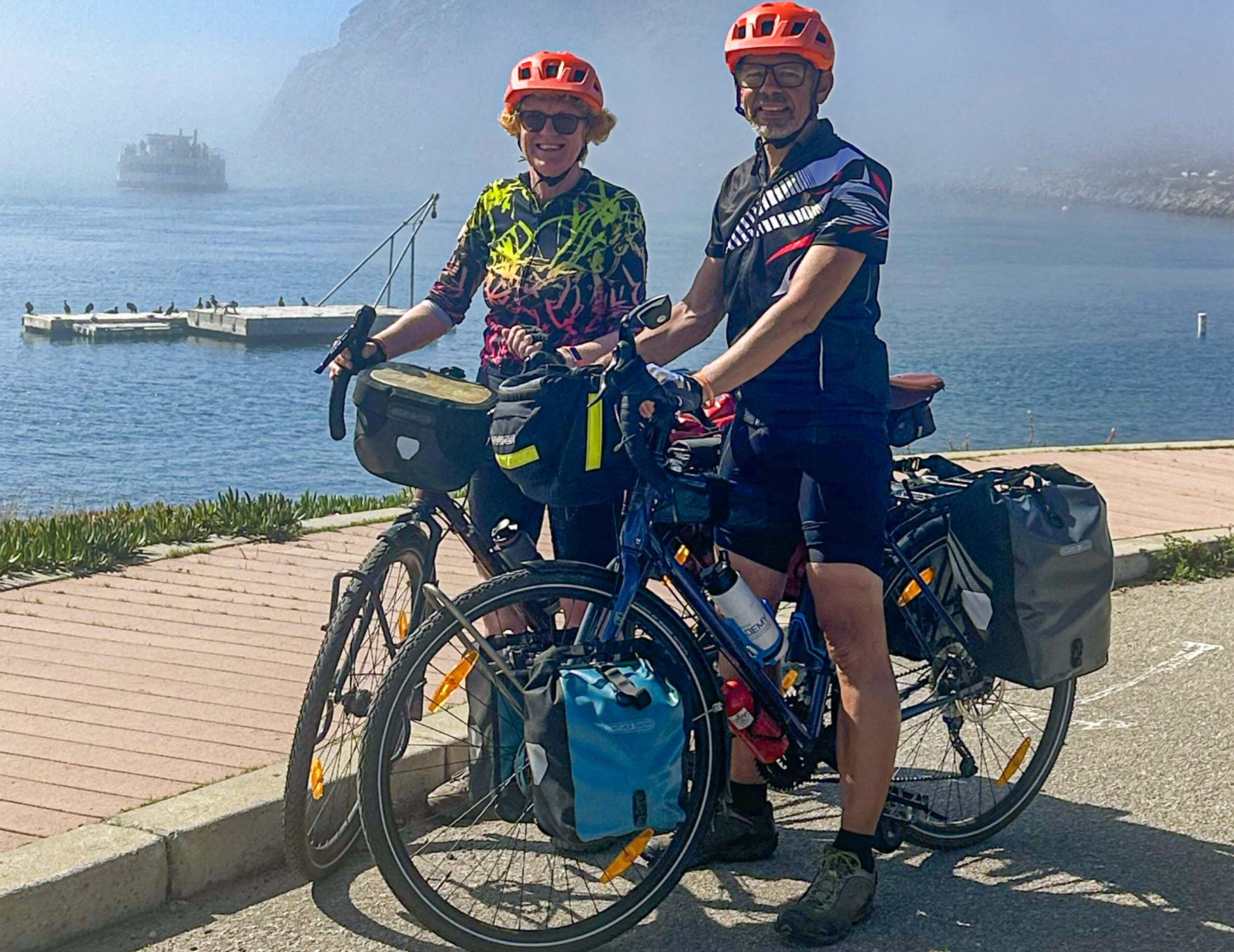
It’s Better to Travel: Paula and Martin Brunt
According to the old saying, it’s better to travel than to arrive. In fact, sometimes the journey – rather than the destination – is the whole point. This month we meet Paula and Martin Brunt who have recently returned from an epic adventure, cycling down the west coast of America to raise money for their chosen charity, Motor Neurone Disease Association
For some people, when retirement beckons it means more time with children and grandchildren, time pursuing hobbies, giving the garden some attention, or socialising… perhaps having the chance to travel, too. For very few people does it involve something as ambitious as an epic cycle ride down the west coast of America; a journey of over 2,400 miles.
However, Paula and Martin Brunt are a bit more adventurous than most, and just before Christmas, the couple returned from a once-in-a-lifetime trip to raise money for charity.
The couple are now based in Oakham, but neither of them originally comes from Rutland. Martin grew up just outside Manchester before going to university and then travelling, eventually landing what he calls his first ‘proper job’ in Milton Keynes, working for a defence company.
Paula grew up in the Republic of Ireland and was also working in Milton Keynes, employed by Unilever in the food industry. It was there that the couple met, through the Milton Keynes Mountaineering Club, which says a great deal about the sort of people they were even then. As Martin puts it, “we were always pretty active,” with cycling, hill walking and trekking forming a big part of their lives long before any major adventures were planned.
Paula moved to the area in the mid-1990s after getting a job in Spalding, initially living on the Stamford side of Rutland, with Martin joining her a couple of years later.
They lived in Ryhall for around fifteen years before moving to Oakham when their boys reached secondary school age, a decision made largely to avoid a long school run.
Both sons, Greg and Ollie, have grown up surrounded by this culture of activity and independence, something that would later play a surprisingly important role in Paula and Martin’s own journey.
Earlier this year, in February, Paula and Martin took the decision to retire early. “We said we’d had enough of the corporate world,” Paula explains. “We decided we wanted to travel quite a bit and do other things with our lives.”
Almost immediately, that intention turned into action. They had a VW camper van converted for them, which they bought in January, retired in February, and by early March were already on the road.
They spent three months touring Europe in the van, returning to the UK in early July. After only five or six weeks at home, they left again, this time for something altogether more ambitious.
The idea of cycling in America had been on their bucket list for years. “We’d always said we’d cycle across America,” Paula says, but the idea crystallised two years ago when Greg bought her a guidebook on cycling the west coast of the United States.
Greg, then just 21, had already completed a year-long solo cycle around the world in 2023, leaving home on his bike and returning 366 days later, having covered nearly 29,000 kilometres. “Our little trip pales into insignificance compared to that!” Martin says.
Seeing what their son had achieved undoubtedly removed some of the mental barriers. As Paula reflects, “He did it on his own, across dozens of countries, different languages, currencies and borders.”
“We were only going to be in one country where everyone spoke English.” The final push to turn a long-held idea into a real plan came with the diagnosis of a close friend. Roddy Grant, a friend from their Milton Keynes days and a keen cyclist himself, was diagnosed in February with motor neurone disease, specifically flail arm syndrome. By July he had already lost much of the use of his hands and could no longer cycle. “That was when we said, let’s do this for Roddy,” Paula explains. “He can’t do it anymore, so we will.”
They began planning the trip seriously during 2024, even booking flights while they were still travelling around Europe in their camper van. Timing was important. They wanted to start in the north in late summer and head south with the seasons, taking advantage of warmer weather and prevailing winds.
On 21st August, they flew from Gatwick to Vancouver, taking their own touring bikes with them, packed into large cardboard bike boxes. A relative of a neighbour kindly collected them from the airport with a trailer, allowing them to assemble the bikes at leisure rather than on the airport concourse.
From the outset, this was a fully self-supported ride. There were no electric bikes and no support vehicle. Everything was carried on the bikes themselves: tent, sleeping bags, mats, camping stove, fuel, food and clothes.
“We had one pair of shoes each,” Martin says, “and flip-flops.” Paula adds, “You can bring what you like, but you have to carry it, so you travel light!”
They planned only two or three days ahead at any time, keeping their itinerary deliberately flexible in case of bad weather, fatigue or mechanical issues, though in the end they suffered no punctures, no breakdowns and no injuries across the entire 2,400-mile route.
After flying into Vancouver, they took a ferry across to Vancouver Island and began cycling south. Their initial daily distances were around 50 to 60 miles, with their longest day coming in at about 65 miles with significant climbing.
As the first few weeks passed and they realised they were ahead of schedule, the couple deliberately slowed down, reducing daily distances to 35 or 40 miles to allow more time for sightseeing… and rest.
“We realised we had lots of spare time,” Martin explains. “So we wound it down and just enjoyed it more.”
Accommodation was a mixture of camping and something they had not encountered before planning the trip, the website www.warmshowers.org. Warm Showers is a global network where cyclists host other cyclists, offering at minimum a shower and a place to sleep.
“It’s like sofa surfing, but you have to turn up on a bike,” Paula explains. Over the course of 83 nights away, they camped around 35 times, stayed with Warm Showers hosts on roughly 45 nights, and used hotels just three times.
State park campgrounds proved especially welcoming, with designated hiker-biker areas where cyclists could always be accommodated without advance booking for a modest fee. The Warm Showers experience became one of the defining features of the journey. Hosts were often cyclists themselves and instinctively understood what was needed on arrival.
“First thing you do, you get a shower, you get changed, you get fed, you get a couple of drinks, and you do your laundry,” Martin says. Paula adds that hosts were generous not because they were supporting a charity ride, but simply because that was the culture.
“The world is full of really good people,” she says. “We’ve found that the vast majority of people are genuine and want to help.”
They crossed from Canada into Washington State, then Oregon, and finally California, which alone accounted for roughly half the total distance.
Along the way they encountered landscapes of extraordinary variety, from the rugged Oregon coast to the towering redwood forests of northern California.
“You don’t really understand the scale of the redwoods until you’re cycling through them,” Paula says. “They’re absolutely huge.”
Wildlife sightings were frequent, including seals, elephant seals and whales visible directly from the coast without the need for boat trips. Although the journey followed the Pacific Coast Bike Route, published by the Adventure Cycling Association, they frequently deviated from the official route where it made sense to do so.
Cycling infrastructure in the United States is inconsistent, and there were moments that required careful judgement. They chose not to cross the Astoria–Megler Bridge, a five-mile crossing over the Columbia River with no hard shoulder, instead hitchhiking with a man who went miles out of his way to help them. “He took us and our bikes across the bridge and dropped us outside the police station,” Paula recalls. “The kindness of strangers was incredible.”
In southern California they faced a compulsory stretch along the hard shoulder of a major interstate highway near Camp Pendleton, the equivalent, as Martin puts it, of cycling along the M25. “There was no alternative,” he says.
“Roadworks took up the entire hard shoulder in places, so you had to pull out into the carriageway to get past the signs.” These moments were uncomfortable but brief, and outweighed by countless highlights.
They made several detours by car to visit national parks that were impractical to reach by bike, including Crater Lake in Oregon, Yosemite in California, and later Joshua Tree and Anza-Borrego in the desert near Los Angeles.
Warm Showers hosts stored their bikes while they explored, sometimes staying multiple nights to allow time for hiking and sightseeing. In Los Angeles, one host even secured them free tickets to Disneyland.
They also witnessed a SpaceX rocket launch near Vandenberg Space Force Base, an unexpectedly low-key event with only a few dozen spectators. “There’s a launch every two or three days,” Martin says. “It’s just normal there.”
The physical demands of the ride were considerable. Over the full distance, they climbed around 120,000 feet in total; roughly equivalent to cycling up Everest four times. Daily energy burn was estimated at around 4,000 calories, and Martin lost about ten kilos over the course of the year.
Surprisingly, muscle pain was not the main issue once they were cycling fit. “It was more our hands and shoulders, because you’re holding the same position all day.”
Weather was generally kind, with one day of torrential rain memorable mainly for the evening spent in a motel drying shoes with a hairdryer. They reached the Mexican border near Tijuana before turning back north for a couple of days to San Diego, where they flew home in late November.
Along the way they raised around £4,400 for the Motor Neurone Disease Association, rising to over £5,000 with Gift Aid. Donations came not only from friends and family in the UK, but also from people they met along the route, including fellow cyclists and complete strangers who were moved by their story.
Looking back, neither of them expresses regret or doubt. “We absolutely loved it,” Paula says simply. They would not repeat the same route, partly because there are so many other places around the world still to see.
Already they are planning further travel by camper van in Spain and Portugal, and a cycling trip in Patagonia with their sons. As Martin reflects, there was a brief moment of apprehension as their plane descended into Vancouver, but it quickly passed. “We thought, Greg did it on his own around the world. We can do this.” And.. they did.
You can still donate to Paula and Martin’s fundraising via www.justgiving.com, search for Paula & Martin’s Pacific Coast challenge or see https://www.justgiving.com/page/paula-and-martin-brunt-usa-west-coast-2000-challenge?utm_medium=FR&utm_source=CL
Read the full story in our March 2026 edition at https://www.pridemagazines.co.uk/rutland-and-stamford/view-magazines?magazine=March-2026