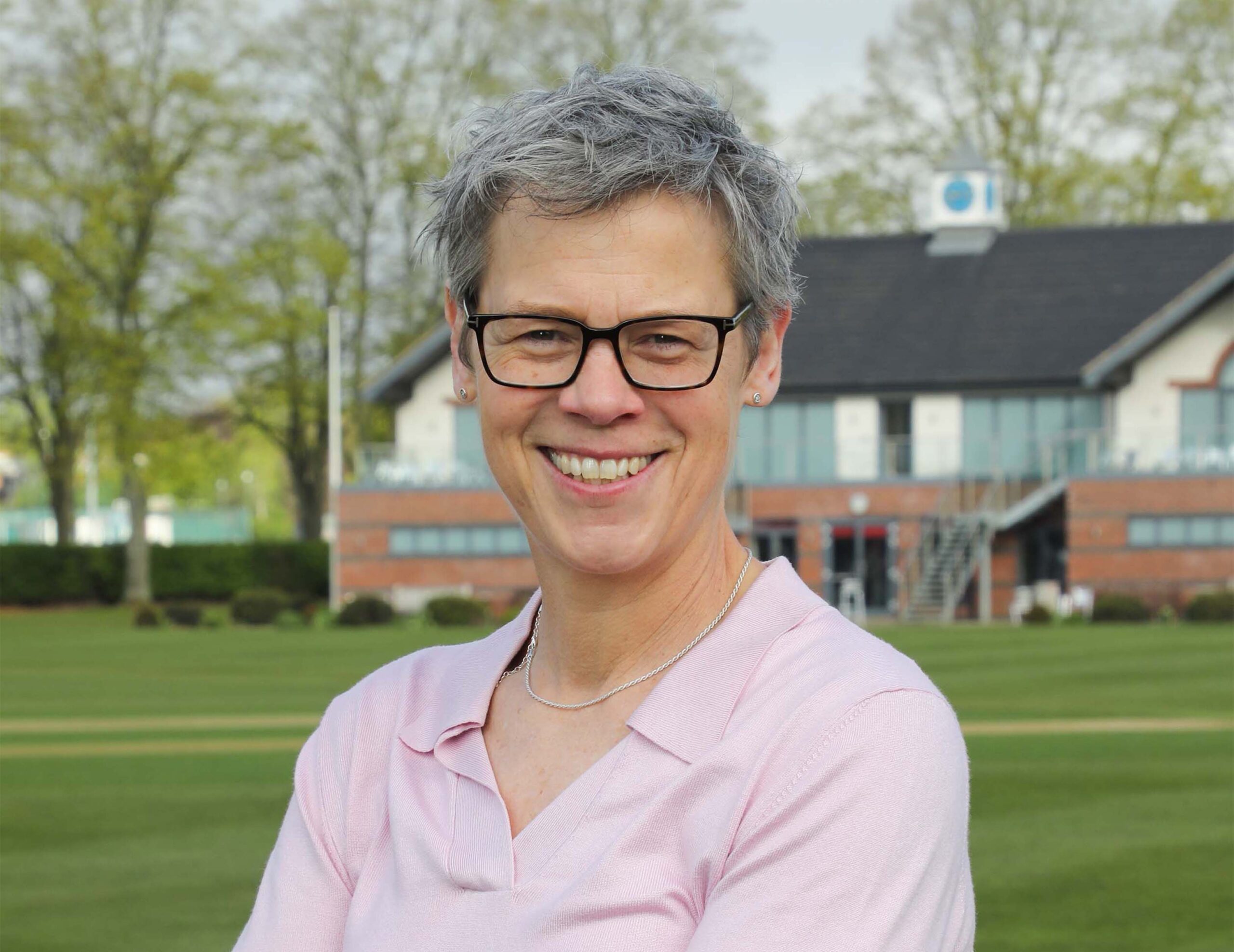
Lucy Pearson, Oakham School’s new headteacher
From Old Oakhamian to England international cricketer Lucy Pearson returns to Oakham School this summer, to mark both a personal homecoming and a historic new chapter for one of the area’s most renowned schools
“It could only be Oakham!” As the saying goes, your school days are the best of your life, and that was certainly true for Lucy Pearson. She looks back on her time as a pupil at Oakham School in the early 1980s with such fondness that she later returned to Oakham as an international cricketer, to impart her enthusiasm for the game to a new generation of pupils at the school.
This September, Lucy will return to Oakham again, this time as its Headteacher, responsible for over 200 members of staff and 810 pupils, including nearly 400 boarders. As the school’s 32nd Headteacher, Lucy will also be the first female Head in its 442-year history.
“My working life has been centred around education. I started out as an English teacher and worked my way up to being a Headteacher, a role I loved. Then I moved to the Football Association as Director of Education,” says Lucy.
“I led the Division whose responsibility was to develop and deliver football’s qualifications for coaches, medics, talent scouts and welfare officers, from grassroots level right up to the WSL and Premier League. It was a really interesting role and great to work in a different sector.”
“After six and a half years at the FA and knowing that I like variety, I decided to move on again, this time to concentrate on a new voluntary role as Chair of the Lord’s Taverners, and to qualify as an executive coach. I was thinking about an eventual return to school leadership and then saw the position of Head of Oakham School being advertised. I realised that if Headship was the direction I was going in, it could only be Oakham.”
After leaving the school as a pupil, Lucy read English at Keble College, Oxford, where she also continued to pursue her preferred sport of hockey. We suspect a degree of false modesty when she says that she was ‘never going to set the world on fire’ in the sport.
As Lucy and a few of her peers were keen to continue playing sport in the summer after the hockey season had finished, they took up cricket instead, and that was when Lucy really found her game.
After graduation, she spent a year in Australia, imagining perhaps that she might drift into a polished graduate scheme and eventually run her own business. Instead, she found herself working in a boarding school in New South Wales, with the English department’s office located in the Sports Hall, “It was the perfect place for me!” she says.
Lucy had originally gone out to Australia intending little more than to have a year away and to think about the future. Instead, she discovered a love of working with young people. “There were two boys in one of the classes I taught who used to make me laugh,” she recalls. “I fell in love with being a teacher, with developing and supporting young people. It was a pleasure and a privilege to be surrounded by the energy, the fun and the drama that young people bring. Although I had intentions for my future to lie elsewhere than education, I realised this was where I really wanted to be. I didn’t want to be sat in an office; I wanted to be in the classroom and on the sports fields surrounded by and working with young people and their energy.”
Whilst discovering the joys of working in education, Lucy also pursued her love of cricket and, in 1996, she was invited to play in a warm-up game against New Zealand. Later that same summer, with New Zealand dominating the Test match series, the national selectors asked her to join the England team for the final Test. “Oakham had taught me about taking opportunities and seeing what happens when you really commit to something. I wasn’t on a talent pathway – I was a wild card really. But once that opportunity landed, I was determined to take it as far as I could.”
Lucy went on to open the bowling for England for nine years, playing in 12 Test matches and 62 one-day internationals from 1996 to 2005. She was twice named Women’s Player of the Year and became only the second woman in over 70 years of Test cricket – and the first for nearly 50 years – to take 11 wickets in a Test against Australia. Forced retirement came in the 2005 World Cup however, when she suffered a third stress fracture and decided that enough was enough.
“I had to admit it to myself and say ‘right, that’s me, I’m done,’” she says. “That is when my career in teaching, which I had been pursuing in parallel, really took off. I loved having both careers and I was very fortunate to have two very generous bosses who recognised the value of having an international sportsperson working in the school; I was able to model having a dual career, having balance and choice alongside showing the great things that sport can bring.” Lucy taught at Wolverhampton Grammar School and then Solihull School as Head of Sixth Form, became Deputy Head at Wellington College before moving to Cheadle Hulme School as Head in 2010. She also served on the England and Wales Cricket Board and is currently Chair of the Lord’s Taverners, which aims to empower young people through cricket and support those living with disabilities or facing socio-economic disadvantage.
Lucy was named as the next leader of Oakham School in November and will take over the role from Henry Price, who is heading to Dubai to take up the position of Principal of Rugby School.
“Returning to Oakham feels incredibly special,” says Lucy. “The school opened doors for me, as it does for so many, not least through the bursary support that makes education here possible for a broad range of people. Without a doubt, the school instilled the skills and values in me that have shaped every stage of my life.”
“The wonderful spirit and ethos of the School remain exactly as I remember them. That was what I wanted to be sure of throughout the recruitment process. School communities naturally evolve – pupils and staff change every year – but the character of a school, its spirit, should endure.”
“A Head’s role is to act as the steward of that spirit: to honour the heritage that generations have built, while ensuring the school continues to best serve its students and prepare them for adult life. The feel of a school inevitably shifts as each leader brings their own ethos and philosophy about education and young people, but that evolution sits alongside a deep respect for the school’s history and its immutable values.”
“Oakham has always been committed to developing the whole person and sought to be inclusive. It was one of the first boys’ independent schools to welcome girls, back in 1971, and it has long recognised the richness that comes from diversity and difference. A community is at its strongest when it brings together people with varied interests, backgrounds and characters.”
“Education is about developing young people who can move positively and confidently into their adult lives; young people who know themselves, who build positive relationships, who contribute, and feel equipped to navigate a changing world. Our job is to give them brilliant learning opportunities inside and outside of the classroom, so that when they leave us at 18, they feel ready for what comes next. That, ultimately, is our purpose.”
Lucy will relocate from Cheshire to Rutland over the summer break and is currently in Oakham every week or two, meeting parents, pupils and staff. It affords the opportunity, she says, to carefully consider the school’s future strategy and establish clarity in its direction from September, when she will officially be in post.
“As a leader, my job is to remove the obstacles that stop people from doing their best work,” she says. “Sometimes that means looking hard at the systems and structures we’ve inherited and asking whether they are still serving us: are they effective, are they enabling, are they adding value? Leadership is also about setting a tone: being positive, being visible, and being an ambassador for the school you are stewarding.”
Lucy describes her values as simple but unwavering. “I believe in treating people fairly. I believe in hard work. And I believe in giving things a go – creating a culture where people feel able to try, to learn and to grow.”
Arguably, such soft skills as these – resilience, emotional intelligence and also the ability to positively interact with one another – are increasingly valuable characteristics for a young person in a world where the Victorian philosophy of education, based on rote learning, has given way to application.
“We now carry vast amounts of ‘knowledge’ in our pockets. With the internet, we have access to more information, more quickly, than at any point in human history,” Lucy says. “But that makes our ability to create, to question and to interrogate what is in front of us more important than ever.”
She notes that artificial intelligence is often presented as the next great leap. “But AI works by analysing everything that has happened before and producing something based on that. The human mind can do something different: it can untether itself from the past and imagine the future. It can create something wholly new.” Critical thinking, she argues, is central to that uniquely human capability. “It’s essential for assessing the information we’re presented with today, especially for young people who must evaluate online content, influencers and AI-generated material. One of the things Oakham taught me was good judgement – something that I believe is more important than ever.”
Lucy also highlights how our understanding of intelligence has broadened. “Literacy and numeracy matter, of course, but so do problem-solving, logic, emotional intelligence and critical thinking. People think differently and learn differently, and they always will.”
That diversity has practical implications. “Take revision,” she says. “As a Headteacher, I absolutely recognise the need for pupils to revise. But effective revision varies enormously depending on an individual’s attention span and whether they respond best to visual, auditory, pictorial or kinaesthetic strategies.”
What she resists is any attempt to impose a single correct way of learning or living. Instead, she talks about ‘freedom under the law;’ the idea that schools can create clear boundaries while still allowing pupils to discover the methods and habits that suit them best.
“We want young people to find their own way,” she says. “To work out for themselves what works best for them rather than dictating that there is only one route to success. It’s simply not true and is another example of where diversity, appreciating and understanding difference, is so important. As much as we want young people to work out their own way, their own path, we need to help them appreciate that others might have other ways and other paths, and that richness is a strength.”
Not only has learning become more challenging, but being a young person today can also be fraught with uncertainty.
This is reflected in the increasingly important role that pastoral care and safeguarding play in education. Lucy is clear that schools must protect children, but equally that young people cannot simply be instructed into wisdom. They must be understood, supported and helped to regulate themselves. In a world of online influence and ever earlier exposure to adult realities, she believes schools must work from the pupil out rather than the adult in.
“The adult has not got the answer,” she says. “We have to work with (and in support of) our young people, not impose on them.” Boarding schools, she believes, have a special role because they create close communities in which human connection can be learned and practised. In an age of fragmentation, that matters. “We need to connect meaningfully,” she says.
Lucy recognises that independent schools such as Oakham have a degree of freedom not always available elsewhere. Qualifications still matter and pupils need outcomes that will stand up in the wider world, but there is room to build something richer around those essentials. She speaks positively about Oakham’s broad offering, from A-levels, IB and BTECs to diverse co-curricular opportunities across sport, the arts, leadership and service. Her instinct is that education should be less constrained by narrow subject boundaries and more alive to the skills that transcend them. “For Oakham, it is about adding value: by making the most of our independence, our heritage, our commitment to diversity and inclusion, and our history of thinking a little differently.”
Even with the challenges that come with teaching and leadership in education, Lucy believes there are few careers as important or as rewarding. “The wonderful thing about schools is they are places for people,” she says. “They are deeply human. That is the joy of it.”
That joy has never left her, whether in the classroom, in the sixth form, in headship or in national sport. Education, for Lucy, is meaningful because it deals in possibility. It’s about helping young people to become ready for the next stage of life, not about producing ‘finished products’ but grounded, thoughtful and capable individuals.
For Lucy, returning to the school that helped shape her is not simply a career move. It is a homecoming, a statement of gratitude and a new chapter in the life of one of Rutland’s most respected schools. More than four centuries after Oakham School first opened its doors, she brings with her a rare combination of elite sporting experience, educational leadership and a deeply personal understanding of the school’s character.
“My favourite time as a Head is when you see the pupils graduating at 18,” she says. “In that brief moment, as they walk across the stage, you reflect on their journey. Some find school easy and that’s wonderful. Others will have found it more challenging. But you see them at 18 and you realise that moment is the gift that the career offers, because you realise they are brilliant. Young people are brilliant.”
Lucy Pearson will be in post from September as Headteacher of Oakham School. See www.oakham.rutland.sch.uk.