English Wine: From Belvoir to Bottle
Find out why English wine is changing the landscape of the countryside, as well as the drink in your glass. From a sunny autumn afternoon in the vineyard to a winter evening in front of the fire we’ve a range of still and sparkling wines from the Duke and Duchess of Rutland’s vineyard
Find out why English wine is changing the landscape of the countryside, as well as the drink in your glass. From a sunny autumn afternoon in the vineyard to a winter evening in front of the fire we’ve a range of still and sparkling wines from the Duke and Duchess of Rutland’s vineyard
Let’s get a couple of things straight. Firstly, it’s beever not bell-vwah. And secondly, the English can make wine – and really very good wine at that – no matter what our slightly stand-offish continental cousins may think.
It’s late September, Tuesday afternoon, about 16°c and it’s nice and sunny. Belvoir Castle’s finest had put the date for the preview of their latest vintage into our diaries weeks ago and as the event drew nearer the organisers of the day, Lizzie, Ellie, and Her Grace the Duchess of Rutland were all watching the weather forecast carefully.
There was, Ellie reckons, a ‘Plan A’ for good weather, then a ‘Plan B’ for bad weather and as the forecast looked increasingly dismal, a ‘Plan C’ for really terrible weather.
Happily, on the day the former was sufficient. Having met at Belvoir Castle we took a bumpy shooting charabanc down the hill to see the remaining grapes on the estate’s vines. The mission was to sample the latest release of wines exclusively produced from grapes grown on the estate. These now comprise two still wines – white and red – and two sparkling wines – brut and rosé.
The English wine market is thriving (see over for more details), as the climate once enjoyed by regions like Reims and Epernay has moved upwards to ensure favourable conditions for vines and wine producers in this country.
Belvoir Castle followed a number of other more southerly wine producers in Sussex and Kent to establish its own vines on five acres of land south east of the castle itself. The land is at an elevation of around 100m above sea level and it has rich, crumbly limestone and ironstone soils which drain very well.
Fancy German kit was used to plant the vineyard in 2019 with GPS ensuring the rows are absolutely straight. Unusually the vines’ second year yielded some decent fruit – sufficient for 700 bottles – but within three years and up to 2025, the site is yielding up to 25,000 bottles a year, depending on what the climate is like in spring and summer.
Unfortunately, that’s where automation ends because viticulture is still a labour-intensive operation. This summer, Dave Crossland – the estate’s lead on vineyard operations – walks around 10 miles each day and has completed the summer pruning of the vines, taking away (with manual clippers and infinite patience) many of the leaves so all that lovely sunlight reaches the grapes and ensures all of the plant’s energy goes into producing fruit.
A dry 2025 has seen a disappointing harvest in other arable sectors such as cereals, but the grapes have loved our sweltering summer.
“The vines have thrived in the heat and the roots have run so deep into the soil that it hasn’t been necessary to irrigate them.”
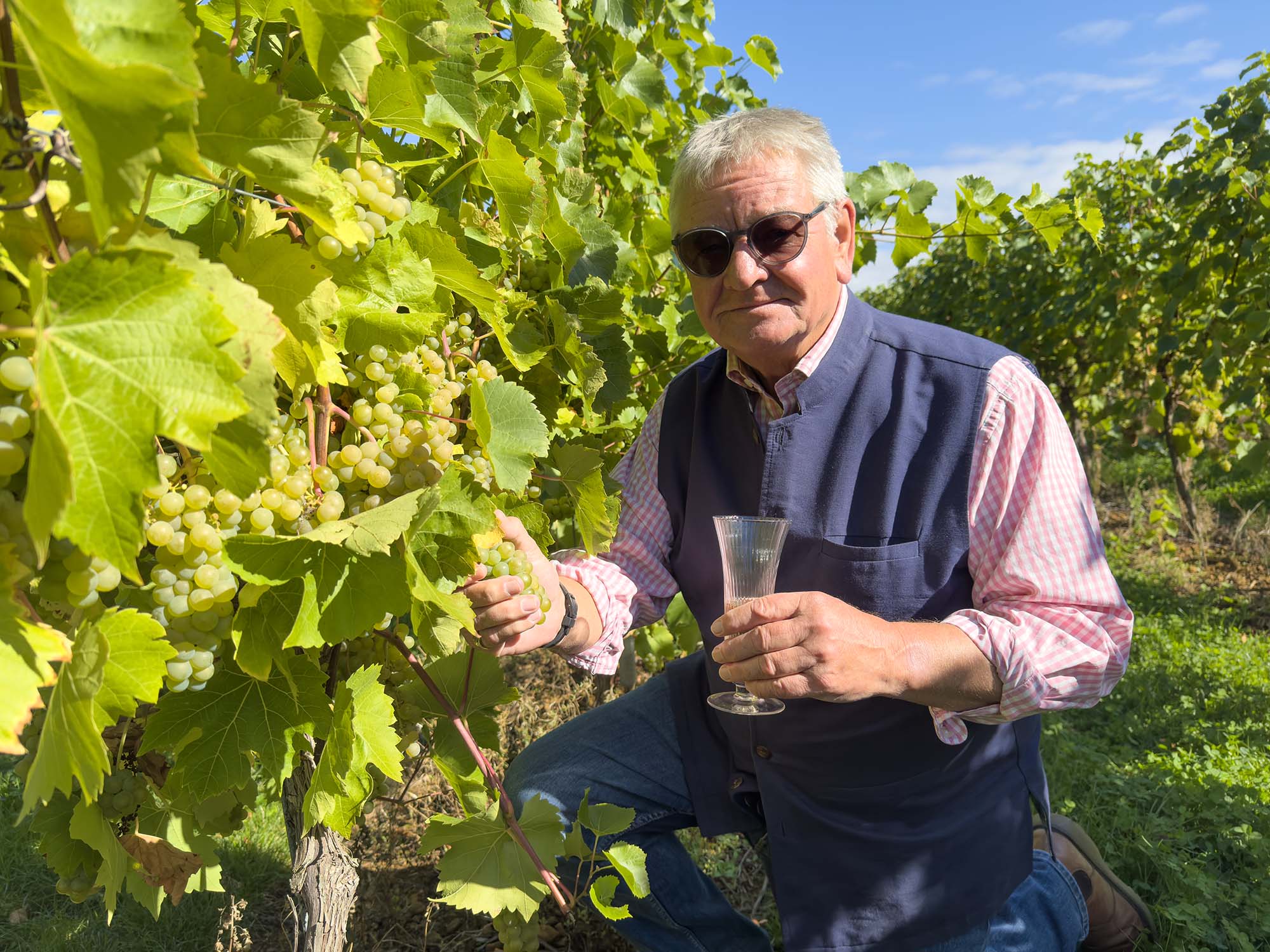
During our visit, only a few grapes remain on the vines – the Seyval Blanc variety. They’ll be ready, we’re told, in less than a week but for now it’s nice for those invited to the event to see the fruit still in situ.
Harvest began in late August, three weeks earlier than usual, and by the end of September, the team had celebrated their largest yield yet.
For Mark it’s a journey marked by both resilience and surprise. “We’ve already harvested the Siegerrebe, Pinot Précoce and Solaris,” says the 16,000-acre estate’s own viticulture consultant, Mark Bygott. “And we’re producing an exceptional crop this year, so we’re really looking forward to seeing that turned into a good quality wine.”
“English wine is growing exponentially,” says Mark. “About a thousand hectares a year are being planted in the UK. We’re not just competing with the global market anymore, but with vineyards springing up across Kent, Scotland and beyond. Even the French are buying land here—they can see that our summers are getting warmer and our wines are getting better.”
Unlike many commercial vineyards, Belvoir’s vines are tended with remarkable intimacy. Each variety plays a part in producing Belvoir’s wines. Solaris is crisp and aromatic; Pinot Précoce is a delicate red; Siegerrebe is an early-ripening grape; and Seyval Blanc is renowned for its sparkling qualities.
“The Seyval Blanc in particular has blown us away this year,” says Mark. “It’s sharper, it makes a brilliant sparkling wine, and this year it’s produced probably the biggest harvest of all.”
Belvoir Castle’s five wines are all light, around 11.5% ABV, making them refreshingly versatile. “They’re wines you can enjoy with a light lunch or at a summer party,” says Mark, “But they’re also great by the fire over winter. Mark has a soft spot for the Pinot Precocé red. “When we first made it, I wasn’t sure,” he admits. “But over time I’ve really grown to love it.”
“My wife, on the other hand, is devoted to the sparkling white – she drinks nothing else. She’s become quite an expert by now, given the amount she’s enjoyed.”
The sparkling wines are made in the traditional method with a second fermentation and a minimum two-year ageing, ensuring quality and complexity.
Until now, Belvoir wines have mostly been sold on-site through the Belvoir Retail Village (previously known as the Engine Yard), at the Castle itself, and for private events. In 2025, however, distribution is expanding, with plans to supply local businesses and offer mail-order through online retail.
“Having realised that we’re producing far more than we first expected, it’s time to share Belvoir wines more widely,” says Mark.
“We want local people to enjoy it, but we’re also ready to reach further afield. We’ve also begun to offer vineyard tours earlier in the year so we can share our winemaking journey with the public. They’ve proved really popular and have sold out every time so we’ll definitely be bringing those back in 2026.”
The vineyard has been a personal project for The Duchess of Rutland, who has championed the estate’s diversification into food and drink.
“Many people know Belvoir for the incredible story of the castle,” she says, “But they don’t realise the estate also produces honey, preserves, game, premium beef — and now our own wine. I’m so excited for people to enjoy our wines and taste a little bit of Belvoir Castle history.”
A castle has stood as the heart of the Belvoir estate for over 1,000 years, with a first castle built by Anglo-Norman nobleman Robert de Todini, a standard bearer at the Battle of Hastings and the first Lord of Belvoir.
It came into the ownership of the Manners family in 1508 and was rebuilt following the English Civil War when it was destroyed by Parliamentarians.
John Manners was created the 1st Duke of Rutland in 1703 and 100 years later the current Belvoir Castle was built by the fifth Duke of Rutland.
Today it’s still home to the Manners family including the 11th Duke David Manners, Emma Duchess of Rutland and heir apparent Charles John Montague Manners, the Marquess of Granby, Lord Hugo Manners and to Lady Violet, Lady Alice and Lady Eliza Manners.
The Duchess has been hands-on from the beginning, involved not just in strategic decisions but in the day-to-day development of the vineyard. Her pride is evident.
“We chose this site for its natural advantages, and it’s paying off. We’re expanding our reach while staying true to our roots. At its heart Belvoir Castle is a historic landmark, but the estate is very much still working agricultural land which feeds the country, and produces exceptional food and drink.”
“The Belvoir estate is a community, and we’ve such a range of talent around us, people who really understand farming and have a keen interest in improving the quality of our food and drink.”
“Whilst viticulture is a relatively new venture, using the land responsibly and sustainably, is what we’ve always done. It’s just another way of working alongside nature and allowing our farmers to feed us whilst looking after the land for future generations.”
Belvoir Castle’s range of wine is now available for purchase at the farm shop at The Belvoir Retail Village (formerly known as The Engine Yard) and via www.belvoircastle.com.