Who is Andrea Jenkyns?
On 1st May 2025, Dame Andrea Jenkyns was elected as the first Mayor of Lincolnshire’s newly-established Combined County Authority. A year on Andrea she reveals what happened next and tells us why, even a year into the job, she’s still ‘just getting started’
50 years ago, Harold Wilson remarked that ‘a week is a long time in politics.’ That was the era before social media and before the 24-hour news cycle. It was also prior to the obsolescence of Lincolnshire’s historic Lindsey, Holland and Kesteven divisions (which had existed since 1889), in favour of our existing county-wide Lincolnshire administration and the subsequent creation of our current district, borough and Lincoln City councils.
Half a century later, in modern politics (national or regional) much more can happen in the space of a week, never mind a year, as Lincolnshire’s first county-wide Mayor, Dame Andrea Jenkyns, is acutely aware. Following the inaugural mayoral election on 1st May 2025, Andrea was voted into the role, securing a majority of 40,000 and a total of 104,133 votes.
It was a nasty, very personal process. “It was a horrible, bruising campaign. It was emotionally draining, and if I’m honest, it nearly broke me,” she said at the time. “It didn’t need to get as vicious. It got very personal with some of the candidates. But something in me said ‘I’m not going to let you get away with it.’”
A year on, Andrea has put that behind her, and now works well alongside even her most bitter former critics, describing most relationships as constructive as she approaches a year in the role.
Andrea wasn’t just stepping into an existing role; she was defining a whole new one, designed to benefit the county by means of greater devolved power and a more direct working relationship with Westminster than Lincolnshire has ever been able to secure.
Given that Lincolnshire already has parish, borough, district and county councils, some were sceptical of another tier of bureaucracy. Meanwhile the title of Mayor was generally understood by the public to involve wearing chains and cutting ribbons, which is a real misnomer in Andrea’s case. The role is radically different to that of a ceremonial mayor.
In fact, Andrea’s role is much more about high-level strategy. It’s also about setting out priorities, securing funding and stimulating growth across Lincolnshire, with vast potential beyond big challenges… as a year in the job has shown.
“It’s been a year now… and what a year,” Andrea says. We’re in her office on the first floor of Lincolnshire County Council’s offices on Newland. A year ago Andrea had neither the office nor her team, and had to secure both.
“I suppose there was a precedent in the sense of figures like Andy Burnham but really I was creating the role from scratch,” she says. “Being a minister for a time I did have an idea of how I was going to approach the role, and I had been elected on the strength of my manifesto, but it was a case of sitting down with Lee Sirdifield (who had previously served as interim chief operating officer before being appointed to the role of Chief Executive in February 2026), and starting to plan how to deliver what we promised.”
“I’m not a politician who believes in just saying something to get a vote, and when politicians do that and fail to deliver, people soon lose faith in them. The role is one with a really wide brief, which does present a challenge, but that’s also what will ensure a Combined County Authority Mayor can deliver the most powerful change.”
So… what does the Mayor do? For a start, like MPs, there’s a huge volume of casework.
“At first I had no one in my direct team, so I was answering my own casework for months, on matters that individuals and businesses could bring to my desk. I was receiving about 5,000 emails relating to casework alone every month. It took ages to recruit someone, and that someone was Josh Turner who now works alongside Grant Clark and Maria Starnes. They’ve managed the caseload really well and cleared the backlog last autumn.”
As well as casework, the office has around 40 projects under consideration at any one time, of which some may prove to be impractical or may not deliver significant economic benefits and therefore remain unlikely to proceed. Those that do are likely to be of a scale that will necessitate years of planning but will deliver huge advantage.
“We had a budget to work with in the first year and we’ve managed to carry some of that budget into our second year. I don’t believe in just spending money and I haven’t gone crazy spending that budget.”
“I think it’s important to lay down foundations and complete feasibility studies to see if there’s a business case for each of the investments that we believe have true potential before we commit to them.”
“When I was an MP, I developed a lot of embassy contacts, so I’ve been working with the Danish, US and Taiwanese embassies and the Indian High Commission to secure memoranda of understanding (MOUs) for future cooperation at a regional level.”
Closer to home, Andrea delivered the budget for her second year in which she announced £53m of additional Local Growth Funding, and more than £131m, which is set aside for transport improvements.
With direct access to the Prime Minister, Andrea can pitch for, and gain access to, funding at the bi-monthly meeting of England’s 14 elected metropolitan mayors.
Andrea is in the room with Greater London’s Sadiq Khan, Greater Manchester’s Andy Burnham and the other mayors, as well as the Prime Minister and senior government figures such as the Deputy Prime Minister, Secretary of State or Skills Minister.
“It’s actually a really constructive, collegiate opportunity,” says Andrea. “You can talk about your area with the other mayors, tell them about the issues that communities face and also discuss some of the things you’re working on. It’s a different atmosphere to what you’re used to seeing in the Commons and we’re not competing against one another as political parties.”
“Sadiq Khan, for instance, invited us up to see how Transport for London works as I’m keen to set up a similar joined-up initiative here, Transport for Greater Lincolnshire (TGFL). We’ve two travel hub pilot schemes in North Hykeham and Gainsborough. Sadiq was very supportive; he offered to organise his team reaching out to us to show us around TfL.”
“We’ve already set up the board, again with the agencies, key decision makers and transport providers all there at the table together to deliver joined-up policies and strategy.”
“The aim is to establish a travel app which will combine live travel information and the location of electric vehicle infrastructure with rail and bus services and walking routes, simplifying the use of public transport, and providing transport for senior citizens, veterans and care system-leavers.”
“But it can also incorporate heritage sites, visitor attractions and routes like the Viking Way and English Coast Path so that we can unlock tourism potential too. On top of that we’ve secured £76m for highways maintenance and road upgrades.”
In practice, I asked, does affiliation to one political party or another prove to be a sticking point when trying to secure funding?
“Yes,” says Andrea. “Definitely. You’ve either got to be a member of the incumbent party or be able to pester people relentlessly… I’m good at doing the latter and I’m happy to do it, if it means Lincolnshire can benefit from the funding I can secure as a result.”
On the subject of collegiate relations with the party to which you’re affiliated, in Andrea’s manifesto was the employment of more scrutiny to prevent wasteful spending, akin to Trump’s much-vaunted Department of Government Efficiency (‘DOGE’).
In practice Andrea now regularly works with Lincolnshire County Council’s leader Sean Matthews to identify efficiencies by scrutinising the council’s PLA spreadsheet line by line each month.
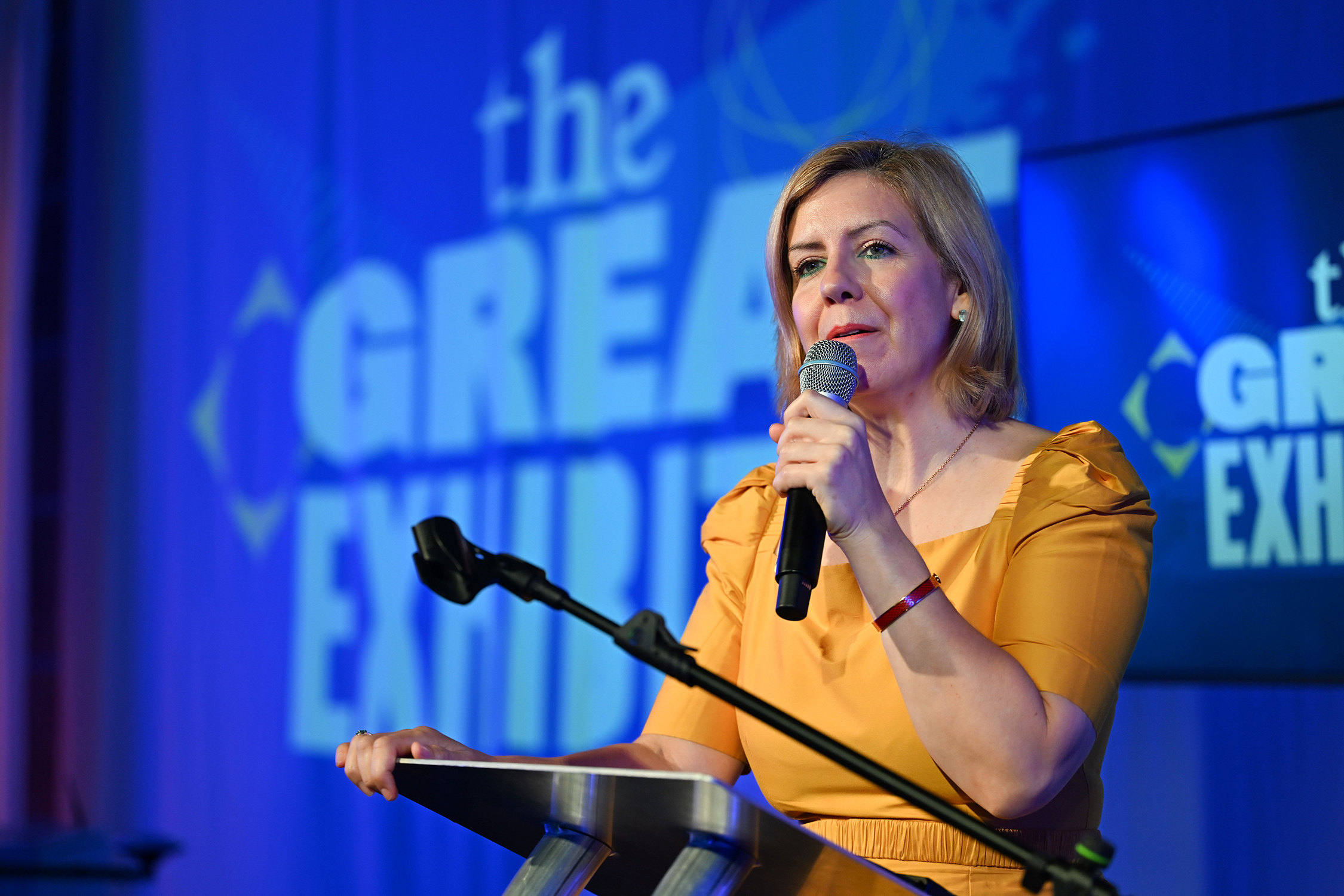
Among Andrea’s mayoral brief is inward investment, business engagement and the development of skills, too. Her Great Lincolnshire Exhibition took place in October, with 90 exhibitors, 700 delegates and companies such as Associated British Ports and Siemens represented across fields as diverse as agriculture, food and farming, plus AI and technology sectors.
The Great Lincolnshire Exhibition will return in 2026, but Andrea has also set aside £20m in her 2026/2027 budget for the creation of an Inventors’ Angel programme to promote innovation and a Mayoral Digital Academy to secure the most relevant future skillsets such as software coding, and to bridge the skills gap between engineering and technology across multiple sectors.
For Lincolnshire’s farmers, a new Farming Industry Technology & Innovation programme will also help our farmers to access new technology, improve productivity and strengthen UK food security. And on 28th April the first meeting of a new triannual Mayor’s Business Guild will convene for networking, operating alongside an Investors’ Fund to help turn innovation into workable businesses. The aim is to keep talent here in the county.
Generally, Andrea is keen to facilitate inter-agency partnerships at the events, and to bring together agencies for more productive, joined-up working relationships.
A good example is the Greater Lincolnshire Enhanced Water Partnership which will align resources and agencies from the Environment Agency and internal drainage boards, plus Anglian Water and the county’s farmers, to both maintain infrastructure and prevent losses and shortages, but also protect against flooding events in the future and ensure sufficient supply of water to new housing developments.
Andrea continues to rally against large-scale solar farms, which collectively total 40,000 acres of land. Much of that land will be taken out of farming and food production when major projects are green-lit by means of Ed Miliband’s large-scale Landmark Planning and Infrastructure designation.
Almost 10% of the UK’s ground-mounted solar infrastructure is already located here in Lincolnshire, reducing domestic food production and increasing Britain’s reliance on more volatile international food supply chains.
Huge solar farms are among the most contentious issues for Lincolnshire residents, and one of the topics most likely to cause locals to gnash their teeth.
Good job, then, that Andrea recently opened the University of Lincoln’s new £1.5m Lincolnshire Institute of Dental and Oral Health (LIDOH). “My own son had to wait two years to get a tooth out, and the desperate need for more available dentistry in the county meant that it was one of the first services we invested in,” she says.
“When a historic failure of investment in such a basic service manifests itself as a young child enduring dental pain you really do want to find practical solutions. And that’s what we have now with a school that, as both a teaching unit and working practice, can treat patients immediately, whilst serving to train future hygienists and dentists too.”
“Already in Britain though, there are peripatetic community dentists who work across different clinics, and I want to conduct a trial to see if we can bring dentistry to rural communities. It just requires somebody to employ joined-up thinking and explore possibilities for a better way of working.”
“Healthcare doesn’t come directly under my remit but when I see a problem I feel compelled to try to fix it, and so I’m due to meet with our local NHS Integrated Care Board to discuss the delivery of local healthcare, because I just don’t believe it’s right to simply say ‘that’s not under my remit.’”
Among Andrea’s other plans are the creation of tourism videos that link in with her planned transport app, plus the promotion of literacy with funds for the delivery of a ‘gold-standard’ inter-agency project to help 200,000 of the least literate people in Lincolnshire overcome the economic barriers that result from being unable to read and write to a reasonable standard.
The most ambitious plan, though, is for the creation of an entire new town. Currently subject to an ongoing feasibility study, it’s an example of how Andrea and the role of a county mayor is not about short-term initiatives or projects. Rather it’s concerned with the creation of larger, long-term economic growth through infrastructure and major investment.
After a year in the job, rather than being overwhelmed by the vast scope of her role, Andrea is emboldened by it.
“The wheel really is starting to turn for Greater Lincolnshire,” she says. “Our aim is to build a county where people can find good jobs close to home and where families and businesses can feel secure and supported in their communities.”
“For many years the national decisions that have been made have often reflected the needs of larger urban areas, and too often rural and coastal communities have faced slower investment and fewer opportunities.”
“We now have a chance to put Lincolnshire people first, and in this role I have the resources and the authority to do just that.”
“Some of the projects we’re working on are slow-burners by virtue of their scale, but they’re also greater in ambition and reward, and that’s exactly what this role involves.”
“I’ve had a busy year, but already a year that shows what potential this role has to deliver a blueprint for Greater Lincolnshire. I may have been in the role for a year, but there’s much more to come in the future. I’m still just getting started!”
See www.greaterlincolnshire-cca.gov.uk.
See our full feature in the May edition of Lincolnshire Pride, https://www.pridemagazines.co.uk/lincolnshire/view-magazines?magazine=May-2026