Friends in High Places: Lincolnshire’s tallest structures
If you’re not keen on heights, you might want to skip these next few pages, because this month we discover the tall stories behind Lincolnshire’s loftiest locations, both historic and modern, architecturally stunning or somewhat more, functional in design, like Lincolnshire’s tallest structure, Belmont Transmitter which, whilst considered to be nationally significant infrastructure, isn’t exactly a looker…
Lincolnshire. It’s flat, right? In fact, 40% of the county’s land lies at or below sea level. So there cannot be many places to enjoy a good view, surely? Wrong.
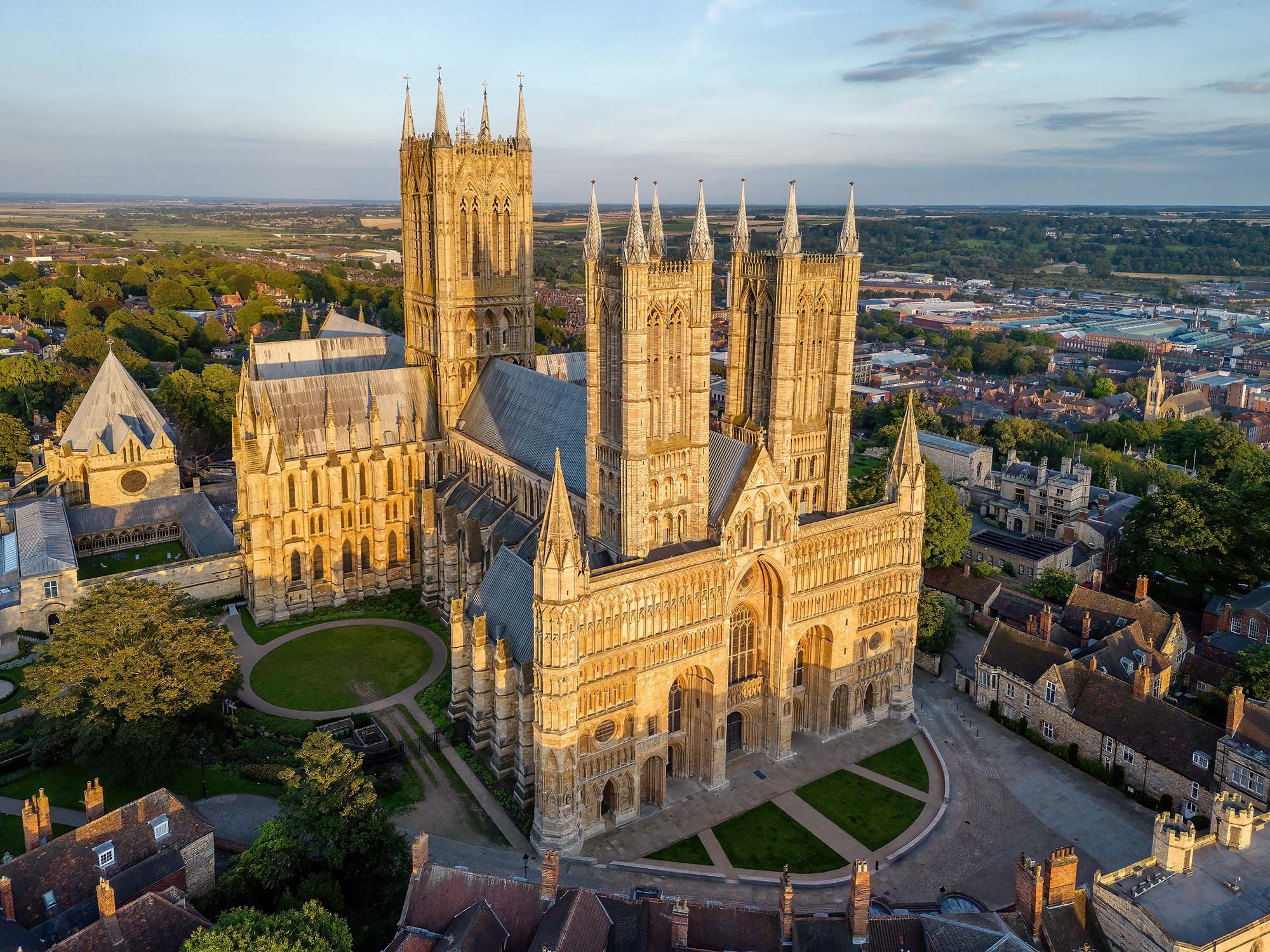
Lincolnshire has a surprising reputation for creating some remarkably tall structures, not least Lincoln Cathedral which, until 1548, was the tallest building in the world. Before that, the cathedral featured a central spire rising to an extraordinary 160 metres.
Unfortunately, during a violent storm, it collapsed and the remains were removed, reducing the building’s height by around 80 metres. Even its two western spires were impressive, raised by 200ft in 1420 before being dismantled in 1807 due to structural concerns.
The shorter cathedral we know today relinquished its title to the Great Pyramid of Giza, itself later surpassed by modern feats such as the Burj Khalifa.
Elsewhere in Lincolnshire, the Humber Bridge stands taller than the cathedral, while a few miles offshore, East Coast wind turbines reach vast heights with rotor diameters of 167m. Yet even these are dwarfed by the 351 metre Belmont Transmitter, still the tallest structure in the county.
Around 23% of people in Britain are acrophobic, so if that includes you, you may wish to skip the next few pages. Otherwise, join us as we explore Lincolnshire’s loftiest locations…
Tall Stories: Lincolnshire’s Lofty Locations
351.7 metres, 1,154ft Belmont Transmitter, 1965.
200m metres, 656ft Offshore wind turbine at Skegness, 2012, (30m hub 167m rotor diameter).
160 metres, 525ft Lincoln Cathedral (pre-1548).
155 metres, 510ft Humber Bridge Towers, 1981.
94 metres, 309ft Grimsby Dock Tower, 1852.
87 metres, 287ft St James’ Church, Louth, 1501.
84 metres, 274ft St Wulfram’s Grantham, 1280.
83 metres, 271ft Lincoln Cathedral (post-1548).
81 metres, 266ft Boston Stump, 1510-1520.
80 metres, 262ft Big Ben, Skegness’s tallest ride, 2025.
77 metres, 254ft Onshore wind turbine at Deeping St Nicholas, 2008, (36.3m hub + 41m radius blade).
40 metres, 130ft Tattershall Castle, 1406-1431.
40 metres, 130ft Moulton Windmill, 1822 sails added 2011, (30m to ogee cap plus 10m radius sails).
36 metres, 117ft Westgate Water Tower, Lincoln, 1911.
351m: Belmont at 60…
We’re taking it from the top, as it were, because the Belmont Transmitter Station is by far the tallest structure in the county. Located a mile west of Donington on Bain, the transmitter recently celebrated its 60th anniversary, becoming operational in 1965 and it’s a lofty 351.7 metres, or 1,154ft tall, making it Britain’s second tallest transmitter after Cumbria’s Skelton at 365m (1,198ft).
Craig Kelly is Head of Field Operations at Arqiva, which owns and operates the Belmont mast as one of its 1,000-strong network of sites across the UK. Arqiva provides critical connectivity services to TV, radio and utility companies across the country and beyond.
The transmitter serves an audience of about 1.6m people, or 800,000 households, from Doncaster down to North Norfolk, and as far west as Worksop, thanks to the flat landscape.
Belmont transmits about 120 TV services and 40 radio stations, but also supports communications infrastructure for the coastguard, utility services (e.g.: smart meters) and vehicle tracking. It consumes around 300kW of power (equivalent to about 20 homes), its 2.7m diameter tower is made up of 375 segments, and the complete tower weighs 210 tonnes. It’s also held steady by three stays 120° apart, and steel guy wires weighing 85 tonnes.
When Belmont was constructed in 1965, it was the tallest structure in Europe, but it was shortened by about 30 metres in April 2010, losing its title as the tallest structure in Britain to Skelton. Technically impressive it may be, but there’s one serious omission: a lift. Any work, such as painting the structure, greasing the stays or installing or maintaining equipment means climbing internal ladders… and dealing with the wind, which is much stronger at 1,000ft.
Only specialist Airworks teams can go to the very top of the transmitter, with all of its electronics and most sensitive equipment. Still, back on terra firma three buildings contain ground-level equipment, and there’s a kitchen and breakout room and there used to be a bunk room and bathroom too. The transmitter is not permanently manned today. It’s managed by a team of 12 engineers based at Emley Moor, Huddersfield.
200m: Powering Homes off the Lincolnshire Coast:
When it comes to doing things at scale, you’ll find it hard to compete with Ørsted. The company currently operates six major wind farms off the coast of the Wash and Humber. Barrow Offshore Wind Farm was completed in 2006 and comprises 30 turbines generating 90 Mw.
Lincs Wind Farm followed in 2012, with 75 turbines five miles from Skegness generating 270 Mw, and Race Bank followed, in 2018, with 91 turbines generating 573 Mw 17 miles east of Skegness.
Next came Hornsea One, a much larger project completed in 2020 and comprising 174 turbines generating 1,218 Mw. The imaginatively titled Hornsea Two was completed in 2022 with 165 turbines, 1,386 Mw. Hornsea 3 is currently under construction, due for completion in 2027 with 213 turbines expected to generate 2,900 Mw, enough to power 3,000,000 homes.
Development of a fourth Hornsea site was cancelled in 2025, but when all sites are operational, the potential for generation 6,437 Mw will generate sufficient electricity to power 6.5m-12.8m homes depending on location and usage.
There are around between 25 and 30m homes in the UK so offshore wind farms can make a significant contribution to supporting Britain’s need for clean energy, so sites like Hornsea 2 (the largest operational wind farm in the UK and upon its launch, the largest in the world) play a vital role in achieving energy security.
But generating vast amounts of energy necessitates vast amount of engineering skill, and some pretty large turbines. All of Ørsted’s turbines are maintained from the company’s East Coast Hub in Grimsby. Engineers live on Service Operation Vessels for two weeks at a time and travel to each turbine, in turn, to carry out work like lubrication and blade maintenance.
Each of the Siemens Gamesa turbine has a rotor diameter of 167m, giving a 21,900m2 swept area, generating 8 Mw, and the hub, in which the electronics and power generation equipment is located.
A single rotation of the blades takes six seconds, and will generate enough energy for a single household for a day. On April 22nd 2026, wind power contributed 2,740 Mw to the National Grid, which was 90% of electricity demand, although this was during a low-demand period; during nominal use periods it can generate between 30% and 40% of the country’s energy use, although energy demands and the output of offshore and onshore turbines varies.
Ørsted employs over 5,600 people including 900 in the UK, with a turnover of €8m. The government hopes that by 2030, 60% of the total energy consumed in Britain is from renewable or low-carbon generation, with 7,500 offshore turbines and a 5,200 Mw capacity by 2030, the equivalent of powering 12,000,000 homes.
Offshore wind turbines are also more popular with Lincolnshire residents than large scale solar farm which takes agricultural land out of food production, such as the Springwell solar farm, approved by The Department for Energy Security and Net Zero despite local objections, which will cover 3,163 acres of land between Lincoln and Sleaford.
155m: The Humber Bridge
Think of Lincolnshire’s tallest structures and after Lincoln Cathedral, the next most obvious example is Barton’s Humber Bridge. Created in 1981, the bridge was once the world’s longest single-span suspension bridge, and today it remains the longest of its kind in the UK and the 14th longest bridge in the world.
Its total length is 1.38 miles (2.2km), and its deck (roadway plus footpaths and structure) is 28.5m (93ft) wide. In terms of height, the roadway across which 35,000 vehicles drive every single day has a clearance of 30m (98ft) above the estuary (although there’s a five metre tidal range).
However, the tower structures soar to a height of 155m or 510ft. Meanwhile, the anchorages into which the cables descend are 35m into the ground on the Barton bank and 21m into the ground on the Humber bank. The towers, meanwhile, have foundations of 36m on the Barton bank and eight metres on the Hessle bank.
The total weight of the structure is 480,000 tonnes, including the 16,500 tonne deck, and holding it up are two cables, each consisting of 14,948 wires, 5mm in diameter, a total of 44,000 miles of wire (enough to go around the moon six times), with both of the 68cm cables weighing in at 11,000 tonnes. The wires descend into the anchorages and each individual 5mm wire is connected to the anchorages underground. The towers are so tall that the top of each is 36mm further apart from one another to account for the curvature of the Earth. It’s an impressive feat of design but it’s also a structure that necessitates meticulous maintenance.
Around 60 people are employed at the structure full time, with external subcontractors and engineers taking the total number ensuring the bridge’s longevity to over 100. Work includes complex, ongoing engineering to manage corrosion, structural wear, and traffic demands.
160m: Lincoln Cathedral (or at least, it was…)
Bruce Hargrave has a head for heights… but in fairness, he has a good incentive. As a former RAF officer, he’s never had a problem with standing on the roof of Lincoln Cathedral’s central tower, 83 metres or 338 steps up, introducing visitors to the 360° views of the county afforded by the rooftop tours that he and about 15 tower guides conduct on Saturdays at 11.15am and 1.15pm.
Bruce has lived in Lincolnshire for 30 years, and had a prior interest in wildlife, ornithology, and nature photography. What really interested him was the opportunity that volunteering at the Cathedral afforded to be closer to the breeding pair of peregrine falcons that reside near the door of the bell tower.
“I’ve been volunteering at Lincoln Cathedral since 2018 and I’ve met some really lovely people, both visitors and fellow volunteers,” he says, “We’ve also formed an informal group of photographers who gather around Minster Yard to capture the birds flying round the building, and as the juvenile birds learn to fly and are fed in mid-flight by their parents.”
Lincoln Cathedral has been home to peregrines since at least the 1920s. However, in the 1980s a purpose-built nest box was created for the birds by Norman Bonner in the east face of the main tower. Initially the birds were named Mr and Mrs P, although the latter was displaced by another bird, christened WSM or Wicked Step Mother by the group of peregrine-watchers.
Right now, Mr P and WSM are looking after their nest, overlooked by discreet cameras, although it’s not clear how many eggs are present this year. The nest has also prompted Bruce and the team to modify the route of their tower tours to ensure the birds aren’t disturbed.
Protected by the Wildlife and Countryside Act 1981, there are only 1,769 breeding pairs in the UK. Last month Bruce welcomed ornithologist Iolo Williams to the Cathedral for a tour organised by Richard Fish, the Market Rasen naturalist who organises wildlife-themed walks and outdoor experiences.
Bruce also released his book, Tales From the Towers, in March, with his own photography, and an insight into how nature, architecture and history all conspire to tell a really wonderful story not just about the birds, but the bell chamber, tower, and the Cathedral.
Bruce is planning a series of Nature and Architecture tours throughout the summer months with dates to be confirmed. He will host these in conjunction with his Tower Tours, which see visitors enjoying views from the landmark, as well as catching a glimpse of the Cathedral’s largest bell, the five-and-a-half tonne Great Tom, which has been chiming the hour since the early C19th… the sound certainly doesn’t seem to disturb the peregrines though, who are very happy at the Cathedral and don’t seem to mind when visitors pop up to admire the view.
Lincoln Cathedral once had a central spire soaring to an astonishing 160 metres, or 525ft, making it the tallest structure in the world. Begun in 1072, the cathedral was largely completed by 1092, but its defining moment came in 1311, when the central spire was finished, surpassing the Great Pyramid of Giza and holding that record until 1549.
The great spire was lost to a violent storm in 1549 (though some sources suggest 1548). Its absence left the cathedral with the distinctive flat-topped tower we recognise today.
In 1420, the western towers were also heightened by 200ft, only to be dismantled in 1807. Architect James Gibbs had warned as early as 1724 that their weight endangered the structure, advice initially ignored amid local unrest.
94m: Grimsby Dock Tower
Grimsby Dock Tower remains one of Lincolnshire’s most striking landmarks. Completed in 1852 and now Grade I listed, the 309 foot structure was designed as a hydraulic accumulator, supplying the pressure needed to power cranes, lock gates and sluices at the height of the port’s industrial success.
A vast wrought iron tank, holding up to 33,000 gallons of water, sat around 200 feet above ground, creating the force required to drive dock machinery. The tower stands 309 feet high and measures 28 feet across at the base, tapering to 26 feet below its first projection, while its walls reduce from 4 feet thick to three feet at the upper courses, a testament to its precise engineering. Designed by James Wild and inspired by Siena’s Torre del Mangia, it combines Italian elegance with Victorian ambition.
Built by James Meadows Rendel using around one million locally made bricks, many formed from clay excavated beside the docks, the structure rests on timber piling foundations. This has given rise to the enduring legend that it stands on a bale of wool, a nod to Lincolnshire’s historic trade.
Opened by Queen Victoria and Prince Albert, the tower remained in use until 1892, when a newer accumulator took over. The original hydraulic lift is no longer operational and access to the top now requires a climb of 445 steps, although modern drone inspections thankfully spare maintenance teams’ legs the ascent. Now under the care of Associated British Ports, it is carefully maintained, ensuring its future as an enduring emblem of Grimsby’s maritime heritage.
87m: Louth’s St James’ Church
St James’ Church in Louth stands as Lincolnshire’s tallest place of worship. It is the second tallest parish church in Britain and ranks among the ten tallest places of worship in the country. Notably, all of those taller are cathedrals (with the exception of the Church of St Walburge in Preston), with Salisbury Cathedral (the country’s tallest place of worship at 123m) leading the list. The church was the vantage point from which William Brown painted his Louth Panorama in 1844, now on display in Louth’s Old Courtroom. The nave’s 27 metres, ensures striking acoustics which will be demonstrated this June when the Louth Male Voice Choir performs on Saturday 20th, followed by The Isla Quartet on 27th, presented by the Louth and District Concert Society. The church is also home to a resident breeding pair of peregrine falcons, currently tending to a clutch of four eggs. Visitors can follow their progress via a live camera feed displayed in the church’s coffee shop.
84m: St Wulfram’s Church, Grantham
St Wulfram’s Church in Grantham has a spire that rises to around 84 metres and was described by Simon Jenkins in England’s Thousand Best Churches as ‘the finest steeple in England. A major effort to preserve it 10 years ago saw the Save Our Spire campaign raise over £600,000 to repair the 14th-century structure, including dismantling and rebuilding the top 12 metres after erosion of internal metalwork caused serious damage. The church also has its share of folklore and local legend. In the 16th century, concern spread through Grantham when a man was discovered sketching the spire and claimed it was to be removed and placed atop St Paul’s Cathedral in London, whose wooden spire had been destroyed by fire in 1561, leading some to fear there was truth in his remark. Another enduring tale suggests the Devil struck the steeple, leaving it slightly askew. Today, St Wulfram’s looks to the future with plans for 78 solar panels, aiming for carbon neutrality, while visitors can climb 211 steps for views across Grantham.
81m: St Botolph’s Church, Boston
“It’s quite a climb… but it’s worth it,” says David Stephenson, Rector of Boston Stump. For the first time in a generation, visitors with obliging leg muscles and enough puff, can now see Boston from a whole new perspective with St Botolph’s Church opening up the highest part of the building’s tower to visitors.
For a number of years, visitors have been able to climb the 209 steps it takes to reach the viewing gallery, just below the louvres where the landmark’s 29 bells hang.
Last month, though, David and the team allowed the public access to the very top of the lantern, the octagonal structure, which necessitates climbing a total of 365 steps.
Doing so takes visitors to the top of the 81 metre (266ft) Grade I listed parish church, built between 1510 and 1520.
“You come out of a very small door in the top turret, and all of a sudden you emerge into this great space on top of the lantern which now has a steel mesh over what was wooden boards, making it easier to walk on.”
The reward for all of that climbing is an uninterrupted view stretching for 32 miles with the Norfolk coast, the City of Lincoln and the vast Fens all visible.
In 2018 and 2019 Boston Stump was covered in scaffolding as restoration was completed, including the replacement of roofing on the belfry. In 2022 the scaffolding was removed and around this time, work also began on restoring the church’s library, located over the south porch.
The library is thought to contain between 1,200 and 16,000 books, not just liturgical volumes, but a 1542 edition of Chaucer and a copy of Foxe’s Book of Martyrs written in 1563 by the Boston-born Puritan clergyman. Its elevated position meant that the books escaped damage when Boston flooded in 2013, leading to water around a foot deep surging into the building.
As well as its tower, Boston Stump is thought to be the widest parish church in England, with a nave 32 metres (104ft) wide. The building is a ‘calendar church’ too, with 365 steps to the top of the tower as well as 52 windows, 12 pillars and seven doors.
There’s also a modern refectory and visitor facilities which have ensured St Botolph’s remains a place for the whole community to come together. The Parish of Boston team has curated a programme of regular events which includes children’s activities and fun for families as well as live music including classical crossover artists G4 at Christmas time and its Friday Night at The Stump dance nights including Northern Soul and Motown events, and 80s and 90s-themed evenings.
Approaching completion is the Lego replica of Boston Stump to which visitors can contribute. When complete it’ll comprise no fewer than 100,000 bricks. Also, this autumn upgraded lighting, which is currently being installed, will enable visitors to light up the building in memory of a loved one and will see different colours to mark different occasions.
High level tours of Boston’s St Botolph’s Church are now available for groups of up to six, booking in advance recommended, £25/person. Call 01205 310929 or see www.parish-of-boston.org.uk.
44m: Pilgrim Hospital
Pilgrim Hospital is Lincolnshire’s tallest hospital. The nine-storey structure is a key regional healthcare hub, it may not rival the sheer vertical scale of London’s Guy’s Tower (the UK’s tallest hospital at 148.65 metres with 34 floors) but it remains an impressive presence locally. Meanwhile, the Lincs & Notts Air Ambulance, though not a hospital, operates at remarkable heights of up to 1,400ft, often descending to just 500ft on life-saving missions. Together, they represent healthcare delivered at every level, from the skies above to the wards below, ensuring vital services reach patients wherever they may be.
40m: Tattershall Castle (Britain’s fourth tallest castle!)
Tattershall Castle stands as one of Lincolnshire’s most remarkable medieval landmarks, notable not only for its scale but as the fourth largest castle in the United Kingdom, after Warwick, Rochester and Caernarfon.
Built in the 15th century for Ralph Cromwell, Treasurer of England, it reflects both power and sophistication, designed as much to impress as to defend.
Unlike many of Britain’s great fortresses, Tattershall is constructed predominantly of brick (700,000 bricks, in fact) rather than stone, a relatively rare choice at the time. This fashion was influenced by Flemish weavers who settled in eastern England, bringing continental building styles with them. The result is a richly coloured, imposing structure that still feels distinctive within the English landscape.
Tree-ring dating has revealed that construction was underway between 1406 and 1431; its surrounding moat still survives, as do its vast fireplaces and grand interiors.
Visitors today can climb its great tower for sweeping views across the flat Lincolnshire countryside, a reminder of its commanding presence. Saved from decline and in the care of the National Trust since 1925, Tattershall Castle endures as one of the finest examples of medieval brick architecture in England.
40m: Moulton Windmill
Moulton Mill, near Spalding, stands as Britain’s tallest working windmill, rising 30 metres to its distinctive ogee cap, with sails extending a further 10 metres. A remarkable £2m, 14-year restoration by the Friends of Moulton Mill saw its sails reinstated in 2011, returning the landmark to its former glory. By 2013, the mill was once again grinding flour by wind power for the first time in a century — a triumph of local dedication and heritage craftsmanship. Today, visitors can explore the mill from 10am to 4pm on weekends and Bank Holidays, with the charming Granary Tea Room offering a delightful pause.
36m: Westgate Water Tower
Compared to some of the structures in this feature, Lincoln’s Westgate Water Tower is a relatively modest 36 metres, yet it remains a striking landmark with a fascinating past.
From 1848, the city drew water from Wickham Garden Reservoir (now Hartholme Park), before an ill-fated attempt to use the River Witham led to a typhoid outbreak. In response, Lincoln was connected in 1908 to a cleaner source at Elkesley, Nottinghamshire. Designed by Reginald Blomfield, the Baroque Revival tower opened in 1911, holding 1,356,000 litres. Once enough for a day’s supply, today it meets just a few hours of demand.
Looking Further Afield
413,000-422,000m (1,354,986-1,384,514ft): Perigee (lowest) and apogee (highest) points of the ISS whilst in orbit over Earth.
8,848.86m (29,031ft): Mount Everest, Nepal/China (Tibet).
1,345m (4,413ft): Ben Nevis, Scotland (UK’s tallest mountain).
828m (2,717ft): Burj Khalifa, Dubai (world’s tallest structure).
625m (2,076ft): Huajiang Bridge in Guizhou, China (tallest bridge).
541m (1,776ft): One World Trade Centre, New York (tallest in US).
330m (1,083ft): Eiffel Tower, Paris, completed 1889.
310m (1,017ft): The Shard, London, (tallest building in the UK).
278m (912ft): 22 Bishopsgate, London, (second tallest).
235m (771ft): One Canada Square, London, Canary Wharf, (third tallest).
189m (620ft): BT Tower, London (completed 1964).
146m (481ft): Great Pyramid at Giza, constructed c.2,600BC.
135m (443ft): London Eye (tallest observation wheel in Europe).
93m (305ft): Statue of Liberty, NY City, dedicated 1889.
96m (316ft): Elizabeth Tower, London.