
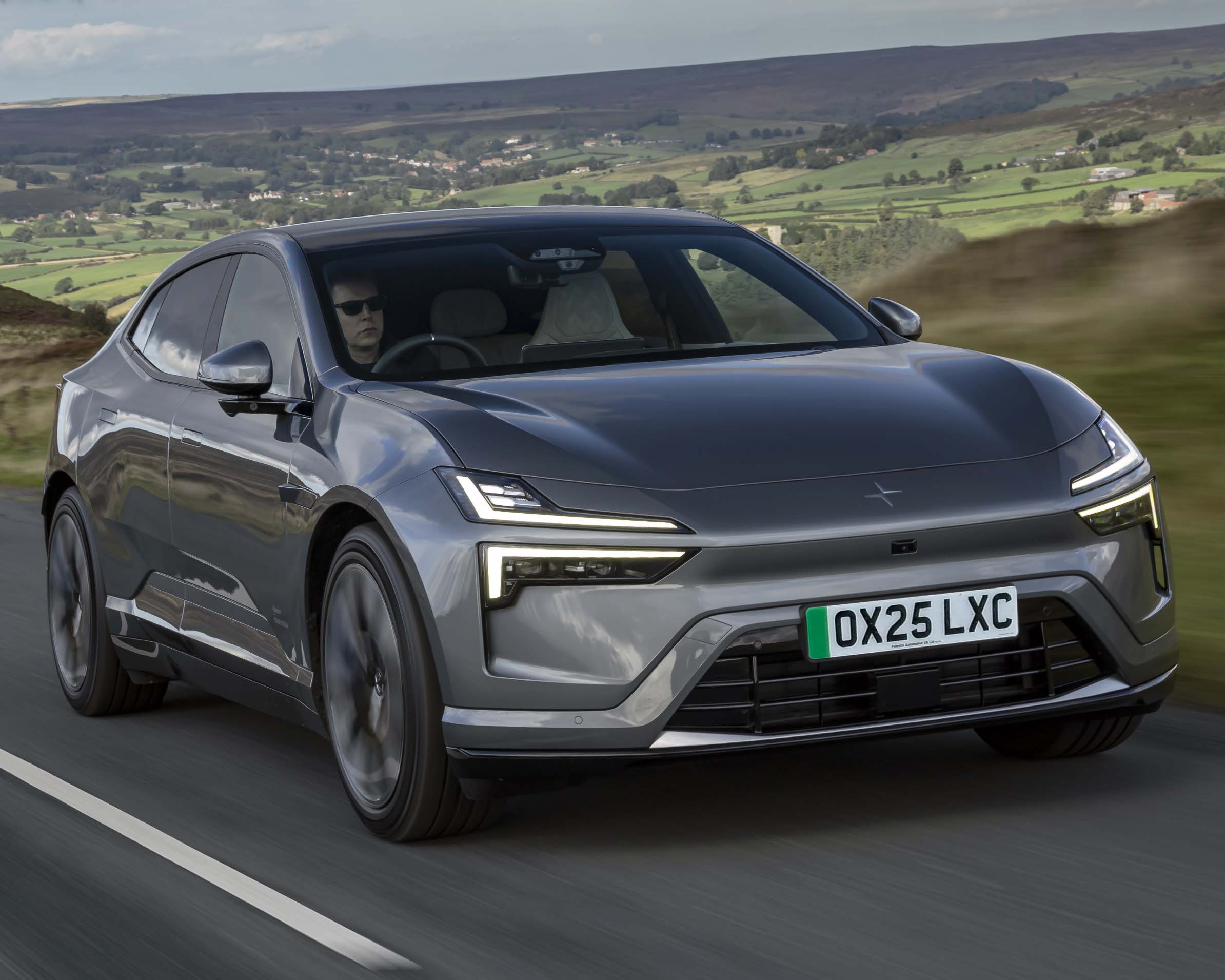
Test Drive: Polestar 4
Proving just how good electric vehicles have become, the genre-defying Polestar 4 is super easy to live with and genuinely desirable. Some credible rivals are due to enter the market but we reckon this is a class-leading offering that’s beautifully designed and offers plenty of driver appeal
Don’t buy a Tesla. Buy, or at least give serious thought to buying, a Polestar 4. There, I’ve said it. Surprising really, because I’ve always been very fond of Teslas, with their minimalist cabins and a desirability that made motorists covet electric cars for the first time. But that was then, and this is now.
Notwithstanding the fact that for those seeking an electric vehicle, a Tesla is no longer the only (or at least the default) option, the uncomfortable truth (for Elon Musk at least) is there are vehicles on the market now that have usurped Tesla in terms of performance, comfort, value for money and that nebulous quality of ‘cool.’
One such vehicle is Polestar 4, and it’s the best evidence we can cite of how good electric vehicles have become, and how the successful integration of technology into a vehicle can make living with one profoundly rewarding.
A genuinely genre-defying product, Polestar 4 simultaneously manages to be a family SUV with five good seats and a decent boot, plus a sleek and muscular-looking coupé and at the same time a luxuriously-appointed executive car. It’s also a bona fide sports car too, as our week with a dual-motor Performance version confirmed. It really is all things to all people; it’s both easy to use and astonishingly enjoyable to live with.
The car first went on sale in Britain from January 2024, joining Polestar 3 (which is a bit larger, and rather more SUV-like in its profile). Polestar’s numeric nomenclature is based on how recently the model launched, and has no bearing on a vehicle’s size or price. For context though, Polestar 4 is longer than a plug-in hybrid Range Rover Velar or electric vehicles like the new BMW iX3, Mercedes’ forthcoming GLC, Volvo’s EX60 or Tesla’s Model Y, against which it will compete in the £55k-£60k mid-sized SUV class.
Polestar 4 is available with a single motor driving the rear wheels for about £55,750, with 288bhp. In this more modest form, the car reaches 60mph in 6.9 seconds and has a range of 385 miles. A dual-motor version is priced from £67,750 and offers all-wheel drive. With 536bhp under your right foot, it reaches 60mph in 3.7 seconds… that’s quicker than a Porsche 911 Carrera. Not bad for a family car.
Polestar 4 is already dripping in standard equipment, and there are no trim levels as such, but you can spec a Pilot pack which adds additional driver assistance systems, or a Plus pack which adds extra toys, from a (magnificent and very clear) Harman Kardon stereo and a head-up display to a heated steering wheel and heated, electrically-reclining rear seats with three-zone climate control and a control screen for the rear seats.
There’s a Performance pack, too, optional on the dual-motor version which backs up the car’s extra power with 22” alloy wheels, gold-coloured Brembo brake callipers, active dampers, stiffer roll bars plus Swedish gold seat belts and dust caps.
First impressions? Even nicer than Polestar 3, and I loved that. The brand is really good at incorporating nice little details that aren’t too showy, but give the impression of a well thought-out and well-reconciled design.
Air curtains are incorporated below the headlights, with aeroblades at the rear too. Frameless windows, mirrors and flush door handles are all nice details, so too is the addition of discreet text with the Polestar name and the vehicle’s power rating.
Whether they do anything for aerodynamics as the designers claim is anyone’s guess but they definitely look smart. The illuminated front badge certainly doesn’t serve a purpose, but it does look very good indeed when you approach the vehicle at dusk.
Also notable is the lack of rear windscreen. This has been subject to debate by motoring journalists, though I’m really not sure why. With a very good parking camera in the centre screen including a rear and an overhead 360° view, I reckon a rear window is redundant.
That’s not stopped Polestar from including a conventional rear-view mirror though, which functions as a traditional mirror to keep an eye on passengers in the back seat. At the flick of a switch, it can also show a rear-facing view from a roof-mounted camera. It works well; nice and bright with a wide angle.
Polestar 4’s cabin is genuinely easy to use and well-reconciled, with a very intuitive design, logical organisation of different settings in a nice sharp, responsive screen with a clean font and good design. But if usability impresses, the material quality is next-level special. The car is designed to be the most recycled, recyclable and the most sustainably-produced, climate-neutral vehicle on the market.
On the dashboard and seats you’ll find a knitted material made from 89% recycled PET. Upholstery is either vegan or Bridge of Weir nappa leather that’s traceable and meets strict animal welfare standards.
Elsewhere in the cabin, there’s a panoramic roof which can be made opaque or transparent at the touch of a button, and LED ambient lighting themed according to the different planets; amber for Venus, blue for Uranus and so on.
In town and just nipping to the supermarket, Polestar 4 is silent, smooth and does a good job of tiptoeing over broken road surfaces. A well-calibrated regenerative braking system allows smooth single-pedal driving too. On A-roads and motorways though, the car’s huge performance becomes apparent. It’s not unruly from a standing start, just responsibly quick. But there’s massive, profanity-inducing acceleration in the mid-range, more ideal for overtaking HGVs on dual carriageways.
Our vehicle was good for a WLTP range of 367 miles, and though the single motor version does a little better on paper, it’s unlikely to make any difference in the real world. Charging from 10%-80% takes 30 minutes using a fast charger, about 11 hours at home from 0%-100%. I’ve not driven the single-motor version but I suspect that’d be quick enough for most people.
Otherwise the dual-motor Polestar 4 does add all-wheel drive which is worth having, and it unlocks the option of the Performance Pack with its gold highlights and pretty wheels.
Our trip from Sleaford up the A1 to see the in-laws usually involves a stop for a rest and a cup of tea. On this occasion however, I did the whole journey in one go, without feeling fatigue or needing to stop for a break. That’s testimony to how comfortably and easily Polestar 4 can dispatch motorway miles.
It’s beautiful from the outside, with a truly outstanding cabin that looks good, feels great and makes good on its promise of sustainability. It’s competitively priced and well-equipped, with more performance than you’ll ever need, and great driving dynamics.
We’ve yet to drive BMW’s iX3 or Volvo’s EX60, or Mercedes’ forthcoming electric GLC, all of which are set to be potential class-leaders, usurping Tesla’s Model Y. For now though, we’re calling it; Polestar 4 is the current class-leader.
If you’re in the market for a car that’s big enough, comfortable enough, practical enough, fast enough and sufficiently rewarding to drive every day, I really don’t think it gets any better than this.
Polestar 4
Long Range Dual Motor
Price: £68,650 as tested (from £50,750).
Motor: Electric vehicle, 400kW, 536bhp, single speed automatic, all-wheel drive.
Performance: 130mph, 0-60mph 3.7secs.
Range/Charging: 367miles range (WLTP), 10-80% 30 mins DC. 0%-100% 11hrs/11kW.
Equipment: Heated electrically adjustable seats, wireless Apple CarPlay/Android Auto and phone charging, power tailgate. Keyless entry, 360° camera, adaptive cruise, panoramic roof. Plus Pack adds Harmon Kardon stereo, head-up display, heated reclining rear seats/steering wheel, three-zone climate.
Call Polestar Sheffield for more information on 0114 551 2900 or see www.polestar.com.