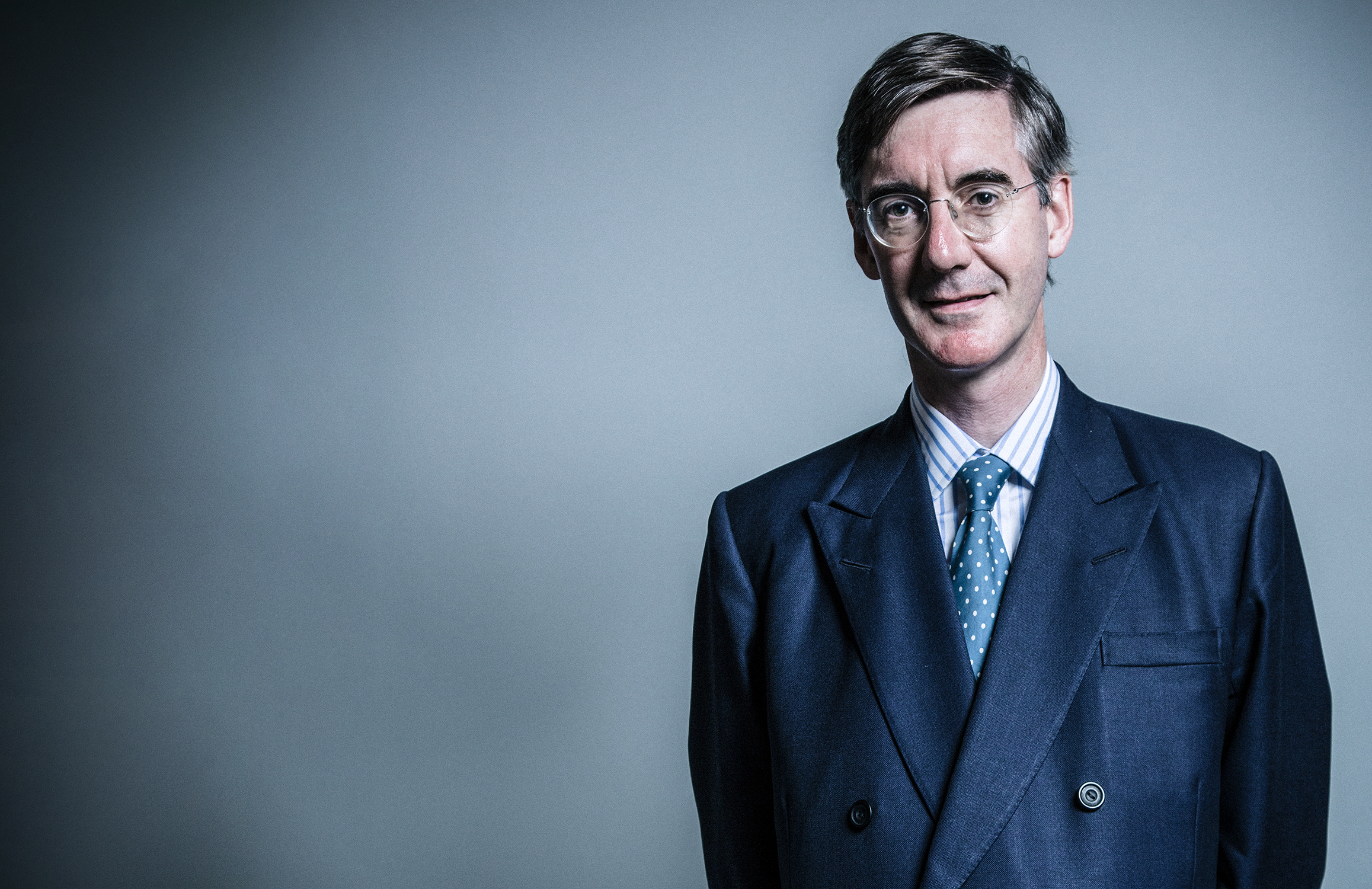
Jacob Rees-Mogg in Lincoln
This month Jacob Rees-Mogg brings an evening of keen wit, unabashed opinion and trademark double-breasted charm to Lincoln Theatre Royal. We couldn’t resist a few words with the Tory grandee, businessman and broadcaster whose tailoring and wit are equally sharp…
If ever there was an antithesis to politics at the moment, it’s Jacob Rees-Mogg in his 1936 3.5-litre Derby Bentley. Ahead of an unprecedented and much-anticipated live tour, the politician, broadcaster and businessman was fresh from a weekend enjoying classic motoring in Somerset. Daffodils. Spring sunshine. Optimistic. All is well.
Elsewhere, UK and global politics was proving rather less cheerful, substantially cooler and much more fast-paced. We spoke in early March when a sulky Trump had just declared Keir Starmer to be ‘no Churchill’ following Britain’s refusal to allow the US military to make use of Britain’s RAF air bases. Firstly then, a caveat. We are some way off our print deadline so by the time you read this, chances are the ‘special relationship’ and the conflict in the Middle East will have evolved significantly, never mind how matters may have developed by the time Jacob’s Mogg Unbuttoned tour takes place.
It’s a modest tour; just five dates including Lincoln’s New Theatre Royal on Tuesday 19th May. The point, he says, is to gauge how much interest future live tours will arouse. Quite a bit, we reckon. A straw poll in the Pride office revealed plenty of interest in hearing from such an experienced politician and incisive social commentator.
“It seems to me that politics has just got faster and faster in recent years,” he told me, though not with a sigh. If anything, he sounds invigorated by it. Jacob is almost liberated by being away from frontline politics and is now able to engage in open discussion and debate.
That is the point of the Q&A sessions on the Mogg Unbuttoned tour and of his willingness to engage with the audiences of his State of the Nation feature on GB News, Monday to Friday from 8pm to 9pm, as well as the audiences of his Substack and YouTube channel.
“This is my first live tour,” he says, although Jacob has appeared alongside The Spectator’s Fraser Nelson before. What he remembers most is the peculiarity of performing to an audience you cannot properly see.
“Normally, if you’re a politician at speaking events, you see your audience, whereas in a theatre you don’t because the lights are so bright.” His solution was ingenious.
“So that I could see my audience, I sold the ice creams in the interval, which I thoroughly enjoyed. People wanted a selfie so they could have one, as long as they bought an ice cream. I did a roaring trade, especially when I recommended my favourite flavour.”
The tour promises to ‘lift the velvet curtain on life in Westminster, from political intrigue to parliamentary peculiarities, as well as inclusion of the moments “one isn’t supposed to mention in polite society.”’ Expect these to be delivered with Jacob’s unmistakable blend of intellect and humour. ‘Exactly how salacious does it get?’ I asked. “I’m not the most salacious person you could meet,” he replied dryly. “But there are lots of things that go on.”
The show is not a lecture, or a party rally.
“It’s exciting to have the opportunity to discuss things with audiences and have an open discussion,” he said. “This is experimental, so we’ll see how it goes. And if people are interested, I’ll probably do it again and add more dates. But this is just to see whether there’s an appetite for it.”
Jacob is not looking for admiration, but argument. “I’m very keen on this. And I want the audience to ask difficult questions. I don’t want them to come along and say, ‘you’re marvellous!’ That’s not very interesting for anybody.”
“I’m keen to be challenged. That’s freedom of speech. And I worry that’s something increasingly regulated in this country.”
The tour is also, in Jacob’s mind, a natural extension of his working life now that he’s out of Parliament. In opposition, he argues, commentary can matter as much as frontline politics. And when you are in the media, rather than in politics, you are even more ideally positioned to provide meaningful commentary.
“It’s very hard in government to do any thinking because you’re racing from pillar to post to catch up with the meeting for which you’re running a quarter of an hour late. It’s very hard to sit back and think, ‘is this the right policy?’”
“In government you need to be in the House of Commons and ‘doing things’ because then you’re making decisions, and the important part of being a minister is making decisions which then have an effect on the future of the country,” he said.
“So I’m very lucky to be able to be a commentator whilst the party is in opposition. It’s proving to be a very interesting thing to do.”
In addition to serving as a presenter on GB News, Jacob regularly writes op-eds for The Telegraph and the Daily Mail. His father, William Rees-Mogg, edited The Times from 1967 to 1981. Jacob also contributes to his Substack account and his YouTube channel, where his Moggologue videos have become part of his public voice.
“It is not just a technical shift, it’s an ideological one,” he says. “It changes what can be said and when. Freedom of speech is much greater once you get off the main channels and you’re no longer regulated by Ofcom.”
The global politics of early March coloured everything we discussed. On the day of our conversation, Donald Trump had just sulkily declared Keir Starmer to be ‘no Churchill.’
“If America decides that conflict is necessary, I think it is in our interest to support them. It’s very sad, actually, that the one thing that Keir Starmer had actually got right was maintaining the ‘special relationship’ and he had managed to get himself into a very good position with Donald Trump, which is important,” he said.
“It’s the most important foreign affairs relationship a British Prime Minister has. It’s not good for the country to be in this position. You always want a British Prime Minister, regardless of party, to have a good relationship with the President of the United States.”
Jacob acknowledged the unease that comes with that. “You may say that’s a bit weak, we’re allowing America to make our foreign policy, but our long-term interests and alliance with America are so important and so fundamental to our own security that we have to put that at the forefront of our minds.”
What matters most, Jacob points out, is what happens after any military action. From Sykes Picot and the Balfour Declaration in 1916 and 1917 to Indian partition and a clumsy withdrawal from the Middle East in 1946 to 1948, Britain’s long and illustrious history of our catastrophic interventions in world politics provides precedent for careful dialogue and cautious post-conflict planning.
“It’s always the consequences of war rather than the war itself. Even if you’ve won the war, what do you do next?”
Meanwhile, Jacob’s Euroscepticism, has not at all softened with time. “I’m still very pro-Brexit,” he said. “Brexit was about our own government having the chance to make decisions, and giving the electorate the right to decide who their government was. That seems to me to be fundamentally important.”
In domestic politics, Jacob believes that the Labour Party is dithering and very much underperforming whilst Reform gathers momentum and the Conservative Party’s reputation is improving, albeit from a low position in 2024. Does Jacob believe that Starmer and Reeves will last the year?
“I’d be very surprised. A recent poll had Labour down to under 100 seats, which means over 300 MPs losing their seats. Kemi’s performances are getting stronger and stronger and there’s a bit of a spring in the step of the party. She’s moving the Conservative Party further to the right, which is where its members and supporters are, but that’s leaving very little difference between the Conservatives and Reform.”
“When things are going quite well the country thinks it can afford Labour, but when things become hard, we do always come back to the Conservatives to make the tough economic decisions.”
“Reform, meanwhile, is doing well. It has great people, such as Richard Tice in my sister’s constituency, but it’s still very much the Nigel Farage party. I see a lot of him at GB News and I like him. He’s a very capable man, but parties need more depth and the Tory party has that extra depth and some wonderful MPs.”
“I’ve a huge amount of respect for Alicia Kearns in Rutland and Stamford, she’s absolutely formidable. I used to have an office next door to her in the Commons and she’s very clear sighted. Victoria Atkins and Caroline Johnson are politicians with great capability and integrity, so we need to really work together as a party.”
“The Conservative Party and Reform working together before an election would be a very powerful combination. I think we should try to work out something – whether it’s a coalition or whether we simply cooperate seat by seat – before the election. That would be my preferred route because if you try to do it after an election you’ve already lost seats.”
“What we want to achieve is so similar that it makes sense for us to work together,” he said. “Splitting the electorate risks letting others get in on a very low share of the vote.”
Lincolnshire is the archetype of Britain’s current political mood, as voters express their dissatisfaction with left-leaning politics and demand a stronger leadership. It is also a county that Jacob knows well. His sister, Annunziata, lives in the county and he visits regularly, especially if he has been invited to address a local Conservative association.
“It’s a wonderful county and Lincoln is very beautiful, especially the approach when you’re some distance from the city and you see the wonderful Cathedral up on the hill.”
A House of Commons doorkeeper who had also served as a guide at Lincoln Cathedral arranged a guided tour of the building for him, an experience he is happy to recommend.
Whether there is time for Jacob to return to the Cathedral or enjoy any of its other highlights remains to be seen, but for real entertainment in Lincolnshire this month, you’ll be hard-pressed to find anything quite as enjoyable, stimulating and as thought provoking as an evening with Jacob. If you’re lucky he may even serve up a selfie and an ice cream too. Oh… and that favourite flavour? Salted caramel.
Jacob Rees-Mogg
Education: Born in London, attended Eton and Trinity College Oxford.
Career: Founded Somerset Capital Management LLP in 2007. MP for North East Somerset from 2010-2024. Served under Boris Johnson and Liz Truss. Leader of the House in 2019-2022. Journalist and GB News presenter since 2023.
Scrabble Credentials: Used the longest word ever recorded in Parliament’s record, Hansard, in 2022:‘floccinaucinihilipilification.’ That’s ‘the action or habit of estimating something as worthless.’ His record was broken by 16-year-old student Michael Bryan in 2017, but we still wouldn’t advise playing Scrabble against Jacob.